

No, and the reason is worth understanding because the deposit itself will often go through. Cards do not carry a name check at the cashier, so a third-party payment can look completely successful right up until the moment you try to take money out. That is when the account name and the payment name are compared, and that is when people discover their winnings are frozen. Permission from the cardholder does not fix it, and using a card without permission is a different and far more serious problem.
The Rule, and Where It Comes From
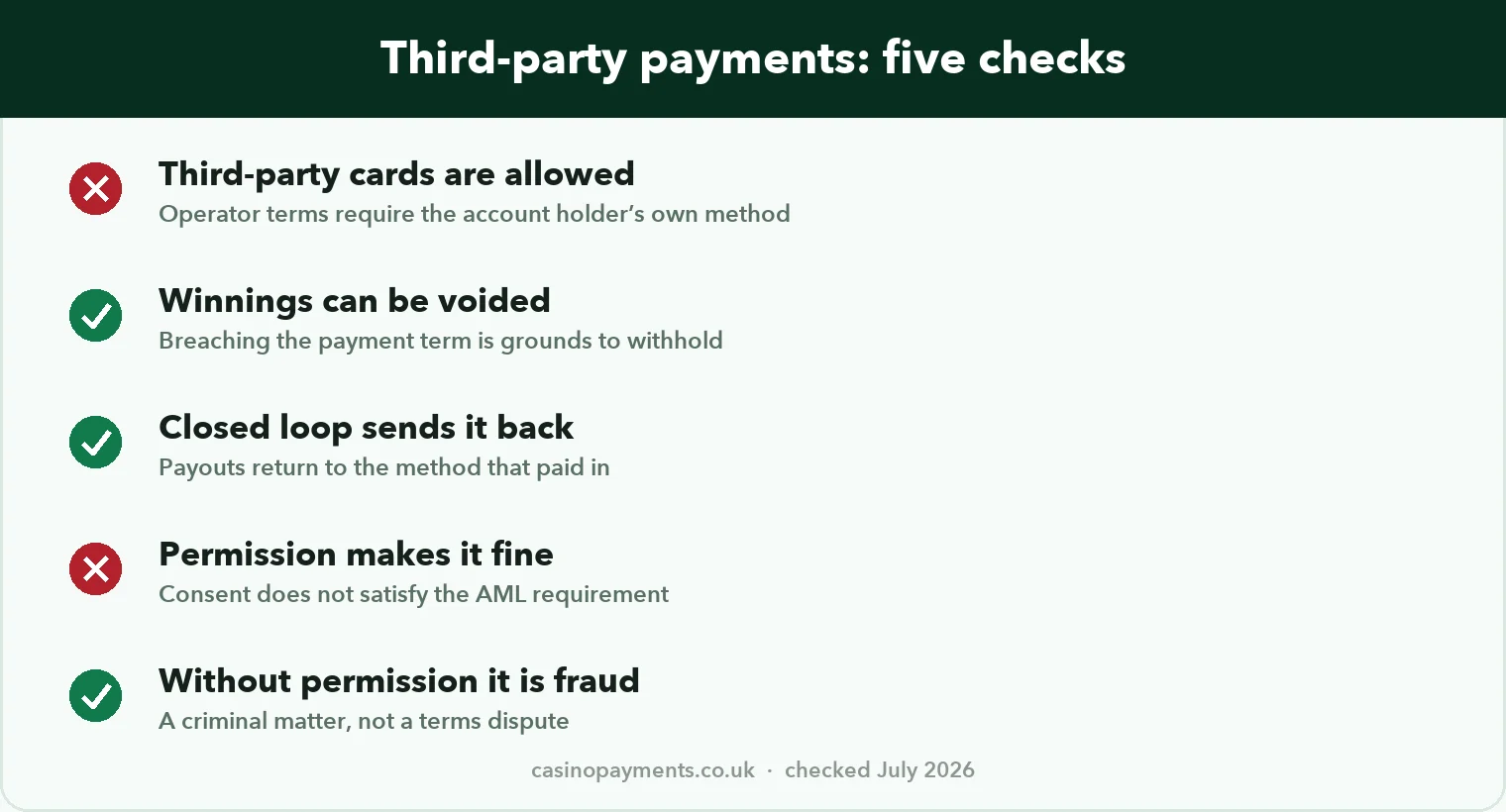
Every UK-licensed operator requires that the payment method used on an account belongs to the account holder. It is in the terms you accepted at signup, and it is not a house preference: it follows from anti-money-laundering duties that require operators to know whose money they are handling. An account funded by someone else breaks the chain those rules exist to maintain.
It also underpins something you may already have met. Closed-loop withdrawals return money by the route it arrived, which only works coherently if that route belongs to you in the first place.
Why the Deposit Goes Through Anyway
Card authorisation checks that the card is valid, that funds are available, and increasingly that the person holds the card through bank-app approval. What it does not do is compare the cardholder’s name against the name on your casino account. Those are separate systems, and at deposit time the cashier is not looking.
So the payment clears, the balance appears, and everything seems fine. The comparison happens later, during verification or at withdrawal, which is why this problem almost always surfaces at the worst possible moment.
What Happens When You Withdraw
- Verification runs and the operator matches your identity against the payment methods on the account.
- The mismatch surfaces. The card belongs to someone else, and the account does not.
- The withdrawal stops while the operator decides what it is looking at.
- Winnings may be voided. Breaching the payment term is grounds to withhold winnings, and operators do use it.
- Deposits are usually returned to the card that paid them, which means back to the other person, not to you.
That last point catches people hardest. The money does not come to you even when it is returned, because closed-loop rules send it back to source. Our guide on when a casino can refuse to pay out covers which grounds genuinely hold, and this is one of the ones that does.
Why Permission Does Not Help
“My partner said I could use it” feels like it should settle the matter, and it settles nothing. The requirement is not about consent between you and the cardholder, it is about the operator being able to identify whose funds are in play. A consented third-party payment is still a third-party payment, and the account is still funded by someone who is not the account holder.
There is a further wrinkle people miss: the cardholder may themselves be self-excluded, blocked, or under an affordability restriction at that operator. Routing money through their card can pull them into something they had deliberately stepped away from.
Using a Card Without Permission
This is not a terms dispute. Using someone else’s card without their knowledge is fraud, and it is treated as such by the bank, the operator and potentially the police. The cardholder can report the transaction as unauthorised, and banks are required to handle those claims promptly.
If you are on the other side of this and have found gambling transactions on your statement that you did not make, our guide to reading a gambling charge on your statement covers how to identify it. Where the person responsible is a family member, that is genuinely difficult, and being honest with your bank about what happened matters more than it feels like it does at the time. GamCare supports people affected by someone else’s gambling, not only gamblers themselves.
The Legitimate Alternatives
If the underlying problem is that you do not have a usable payment method of your own, there are routes that do not breach anything:
- Your own debit card, which is the default and the simplest to verify.
- Open banking, paid from an account in your name with bank-app authentication.
- Vouchers bought with your own money, which remove the card question entirely, though payouts then need a registered account in your name.
- Pay by mobile on a phone contract in your name, capped and deposit-only.
What none of these solve is a genuine funding problem. If money for gambling is having to come from someone else, that is the more important signal in the situation.
Joint Accounts and Shared Households
A joint account is a real grey area and worth handling carefully. The card is in your name and the funds are legally yours as well as the other holder’s, so it is not a third-party payment in the way a partner’s personal card is. Operators generally accept a card in your own name from a joint account.
The practical caution is that the other account holder will see the transactions, and a descriptor that means nothing to you means nothing to them either. If a shared account is being used to keep gambling out of view, that is worth being honest with yourself about.
Verdict
Use your own payment method. The deposit clearing tells you nothing, because the name check happens at withdrawal, and by then your winnings are exposed and the deposits will go back to the cardholder rather than to you. Permission changes none of that, and using a card without permission is fraud rather than a rules breach.
If the reason for reaching for someone else’s card is that your own accounts are blocked, limited or self-excluded, those controls are doing exactly what they were set up to do. BeGambleAware and the National Gambling Helpline on 0808 8020 133 are free and confidential at any hour, and our responsible gambling page sets out the tools that hold at the payment level.
Third-Party Payment FAQs
Can I use my partner’s card at a casino?
No. UK-licensed operators require the payment method to be in the account holder’s own name, and that requirement comes from anti-money-laundering duties rather than house preference.
The deposit went through, so is it fine?
No. Card authorisation does not compare the cardholder’s name against your casino account name. The comparison happens at verification or withdrawal, which is when the problem surfaces.
Can a casino void my winnings for using someone else’s card?
Yes. Breaching the payment term is grounds to withhold winnings, and operators do act on it. Deposits are usually returned to the card that made them, meaning to the other person rather than to you.
What if the cardholder gave me permission?
It makes no difference. The requirement is about the operator identifying whose funds are in play, not about consent between you and the cardholder. A consented third-party payment is still a third-party payment.
Is using someone else’s card without asking a crime?
Yes, that is fraud rather than a terms breach, and the cardholder can report the transactions to their bank as unauthorised. Banks are required to handle unauthorised-transaction claims promptly.
Can I use a joint account card?
Generally yes, where the card is in your own name, since the funds are legally yours as well. Be aware that the other account holder will see the transactions on the statement.
What should I use instead?
A debit card in your own name, open banking from your own account, vouchers bought with your own money, or pay by mobile on a contract in your name. All avoid the third-party problem entirely.
Someone used my card to gamble. What do I do?
Contact your bank and report the transactions as unauthorised, and be straightforward about the circumstances even where a family member is involved. GamCare supports people affected by someone else’s gambling as well as gamblers themselves.
Sources & verification: checked 25 July 2026. UK-licensed operators require the payment instrument to belong to the account holder, a term that follows from anti-money-laundering obligations on operators to establish whose funds they are handling, and which is reinforced by closed-loop payout rules returning money to its source. Unauthorised use of another person’s card is a fraud matter for the cardholder’s bank rather than a contractual issue with the operator. See gamblingcommission.gov.uk. 18+ · begambleaware.org
