

Technically, yes — you can ask your bank to dispute a casino deposit, and in the right circumstances the money comes back. If someone used your card without permission, if you were charged twice, or if a payment went through that you never authorised, UK law is firmly on your side and your bank is obliged to put it right quickly. Those are exactly the situations chargebacks and the unauthorised-payment rules exist for.
What a chargeback is not is an undo button for gambling. If you deposited with your own card, passed the casino’s identity checks, played the money and lost it, a dispute claiming the transaction was fraudulent is very likely to fail — and the attempt can cost you far more than the deposit. Casinos treat false disputes as first-party fraud. Expect a closed account, confiscated balances, a ban across every brand in the group, and in some cases debt collectors or a fraud marker. Banks take a dim view of it too.
This guide sets out both sides honestly: how chargebacks actually work on the debit cards UK players use, when a dispute is legitimate, what really happens after you file one against a casino, and the routes that work better when a casino genuinely owes you money — including the complaints ladder, ADR and the Financial Ombudsman for the banking side.
What a chargeback actually is
A chargeback is a card scheme process, not a law. When you dispute a transaction, your bank raises a claim through Visa or Mastercard’s rules and tries to pull the money back from the merchant’s bank. Visa’s own guidance is clear on the basics: you normally have up to 120 days from the transaction to claim, you are expected to try resolving the problem with the seller first, and a chargeback is not a legal right — a refund is never guaranteed. The merchant gets to respond with evidence, and the scheme rules decide who wins.
For UK gambling there is one big structural point to understand first: since 14 April 2020 the Gambling Commission has banned credit cards for virtually all gambling in Great Britain, online and offline. That matters for disputes because Section 75 of the Consumer Credit Act — the strong joint-liability protection people associate with card claims — only applies to credit cards, so it almost never comes into play for casino deposits. In practice nearly every deposit is made from a debit card or a linked e-wallet, and debit disputes run purely on the Visa and Mastercard scheme rules described above.
If you are wondering why your credit card is declined at every UK site, that ban is the answer — we cover the detail on our credit card casinos page. No licensed GB operator can take one.
When disputing a casino deposit is legitimate
Genuinely unauthorised payments are the clearest case, and here the protection is statutory, not just scheme rules. Under the Payment Services Regulations 2017, if a transaction was not authorised by you, your bank must refund it and restore your account — as soon as practicable, and no later than the end of the business day after it becomes aware of the problem. The main exception is where the bank has reasonable grounds to suspect you acted fraudulently. You must report the transaction without undue delay, and no later than 13 months after the debit date, though in reality you should call your bank the moment you spot it.
Legitimate grounds for disputing a casino payment include a stolen or compromised card being used to deposit, a casino account opened in your name by someone else, a child or another household member using your card without your knowledge, being charged twice for one deposit, or being debited an amount you never agreed. Technical errors — money taken with no corresponding credit ever appearing in your casino balance — also belong in this bucket if the operator will not fix them.
What does not belong in it: deposits you made yourself. In card scheme terms the casino’s service is accepting your stake and settling the bet, and that service was provided the moment you played. “The goods never arrived” logic does not map onto a lost wager.
What actually happens when you dispute a casino deposit
When your bank raises the dispute, the casino’s payment provider is notified and the operator gets the chance to fight it — a process called representment. Online casinos are unusually well equipped for this. Under their licence conditions they verify your identity and address before you can gamble, so they can hand the bank your KYC documents, the registration details matching your name, the IP address and device you deposited from, your login history, and a timestamped record of every bet the deposited funds were used for. Against that file, a claim that the deposit was unauthorised is very hard to sustain if you made it yourself.
If the evidence shows genuine fraud — your card used by a stranger on an account that is not yours — you will get your money back, and quickly. If the evidence shows you played the funds, the bank will usually reverse the provisional credit and close the dispute in the casino’s favour. Either way, expect the casino to freeze or close the gambling account while the dispute runs, since a payment dispute and an open account do not mix.
The real cost of a false chargeback
Filing a chargeback on money you knowingly gambled is often called “friendly fraud”, and there is nothing friendly about how the industry responds. The standard terms of UK casinos treat it as a serious breach. The typical consequences stack up fast: permanent account closure, any remaining balance and pending winnings voided, and a debt recorded against you for the disputed amount if the casino already paid out. Operators pursue those debts, sometimes through collection agencies, and an unpaid collection can end up affecting your credit file even though the chargeback itself never touches it.
The damage also spreads. Most casino brands sit inside larger groups sharing one platform and one security team, so a chargeback at one site routinely blocks you across every sister casino, and operators share fraud data with each other and with payment providers. A bank that concludes you made a dishonest claim can close your account and file a fraud marker, which makes ordinary banking harder for years. Set against a deposit you were never likely to recover anyway, it is a spectacularly bad trade. If your account was shut with money still in it during a dispute, see our guide to what to do when a casino closes your account with money in it.
The better routes to getting your money back
If a casino genuinely owes you money — a withheld withdrawal, a voided win you believe was valid, a deposit that vanished — the effective route is the complaints ladder, not the bank. The Gambling Commission’s guidance is that you complain to the operator first, who has eight weeks to resolve it. If you are not satisfied, you escalate to the operator’s approved Alternative Dispute Resolution (ADR) provider, an independent adjudicator every licensed casino must offer. The Commission itself does not resolve individual disputes, but it does act on patterns of complaints against licensees.
The Financial Ombudsman Service sits on the banking side of the fence. It cannot rule on the casino, but it can rule on your bank — if the bank mishandled an unauthorised-transaction claim, refused a refund it owed you under the Payment Services Regulations, or failed in its duty to treat a customer in financial difficulty positively and sympathetically. The Ombudsman has looked at plenty of gambling-harm cases; its position is that banks cannot simply block payments you authorised, but they are expected to support vulnerable customers properly.
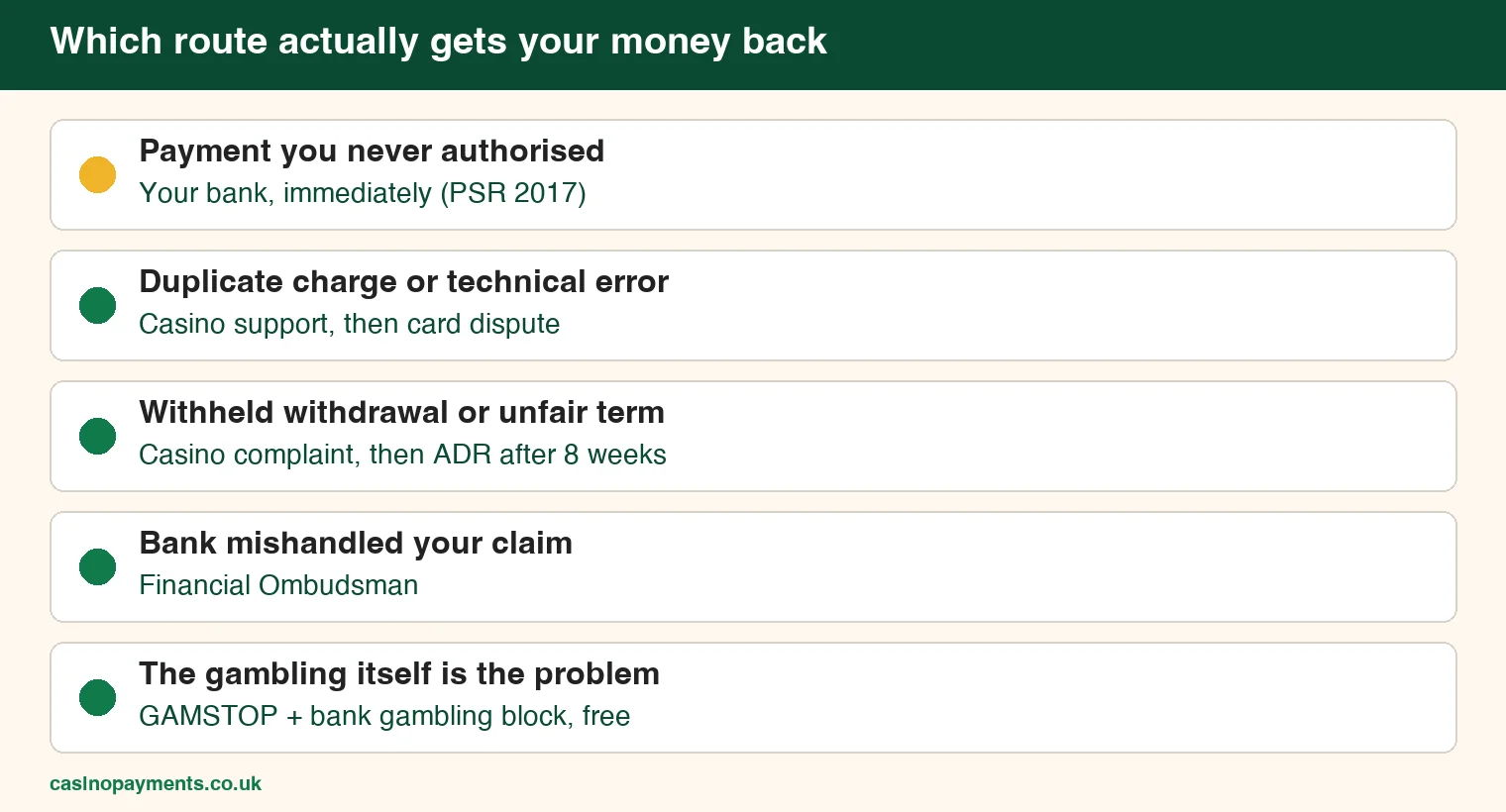
| Your situation | The right route | Who decides |
|---|---|---|
| Payment you never made or authorised | Report to your bank immediately as unauthorised (PSR 2017) | Your bank; refund due by end of next business day |
| Duplicate charge or technical error the casino won’t fix | Casino support first, then a card dispute via your bank | Card scheme rules (usually 120-day limit) |
| Withheld withdrawal or unfair term | Casino complaints procedure, then ADR after 8 weeks | Independent ADR adjudicator |
| Bank mishandled your dispute or ignored vulnerability | Complain to the bank, then the Financial Ombudsman | Financial Ombudsman Service |
| Gambling itself is the problem | GAMSTOP, bank gambling block, GamCare support | You — the tools are free |
If the real problem is the gambling
If you are researching chargebacks because deposits keep happening that you regret, the honest answer is that clawing one deposit back solves nothing — but the blocking tools genuinely work. GAMSTOP is the free national self-exclusion scheme: one registration blocks you from every GB-licensed online casino and betting site for the period you choose. It takes minutes and operators are required to enforce it.
Alongside it, most major UK banks now offer a free gambling block on debit cards, which declines gambling transactions automatically. Crucially, these blocks come with a cooling-off period — typically 48 to 72 hours after you switch the block off before gambling payments will go through again, with some banks offering much longer — which is exactly the friction an impulsive moment needs. We explain how the cooling-off mechanics work in our guide to removing a gambling block, which is worth reading before you set one so you know what you are committing to. For confidential support, GamCare runs the National Gambling Helpline on 0808 8020 133, free and open every day.
Casino Chargeback FAQs
Can I charge back casino deposits because I lost the money?
No. A chargeback is for transactions that were unauthorised or went wrong, not for bets you placed and lost. If you deposited from your own card, passed the casino’s identity checks and played the funds, the operator can prove the service was provided and the dispute will almost always fail. Worse, claiming a genuine deposit was fraud invites account closure, debt collection and a possible fraud marker.
How long do I have to dispute a casino transaction?
For a card scheme chargeback, Visa’s guidance is that you usually have up to 120 days from the transaction, and you should raise the problem with the casino first. For a genuinely unauthorised payment, the Payment Services Regulations 2017 give you up to 13 months from the debit date to notify your bank — but they also require you to report it without undue delay, so call your bank the day you spot it.
Will a casino chargeback affect my credit score?
Not directly — chargebacks are not reported to credit reference agencies. The risk is indirect: if the casino is owed money after the dispute and passes it to a debt collector, a default can reach your credit file, and a bank that decides you made a dishonest claim can close your account and record a fraud marker, which affects future applications for banking products.
Can I complain to the Financial Ombudsman about a casino?
Not about the casino itself — gambling operators fall under the Gambling Commission’s regime, so disputes with them go through the operator’s complaints procedure and then an approved ADR provider. The Financial Ombudsman covers the payment side: complaints about how your bank handled an unauthorised-transaction claim, a refused refund, or a failure to support you as a customer in difficulty.
Sources & Verification
- Payment Services Regulations 2017, regulation 76 — verifies the bank’s duty to refund an unauthorised transaction no later than the end of the next business day
- Payment Services Regulations 2017, regulation 74 — verifies the 13-month deadline for notifying your bank of an unauthorised or incorrect payment
- Visa UK, chargeback and purchase disputes — verifies the 120-day claim window, the contact-the-seller-first rule, and that chargeback is not a legal right
- Gambling Commission announcement — verifies the ban on credit card gambling in Great Britain from 14 April 2020, with non-remote lotteries exempt
- Gambling Commission, how to complain — verifies the operator-first complaints process, the eight-week deadline and escalation to an approved ADR provider
- Financial Ombudsman Service, gambling-related harm complaints — verifies that the Ombudsman covers banks’ handling of gambling payments and vulnerable customers, not the casinos themselves
- GAMSTOP — verifies the free national self-exclusion scheme covering GB-licensed online gambling sites
- GamCare — verifies the National Gambling Helpline (0808 8020 133) and free support services
