
BLIK asks you to remember nothing and register nowhere. Open your Polish banking app, tap for a six-digit code, type it into whatever you are paying, confirm in the app. That is the entire system, and Poles now use it for billions of transactions a year — more than cards for online purchases. It is unavailable outside Poland, and the country’s gambling monopoly makes “BLIK casinos” a stranger topic than most regional payment pages.
Why BLIK Never Reaches a UK Cashier




| BLIK & UK Casinos at a Glance | |
|---|---|
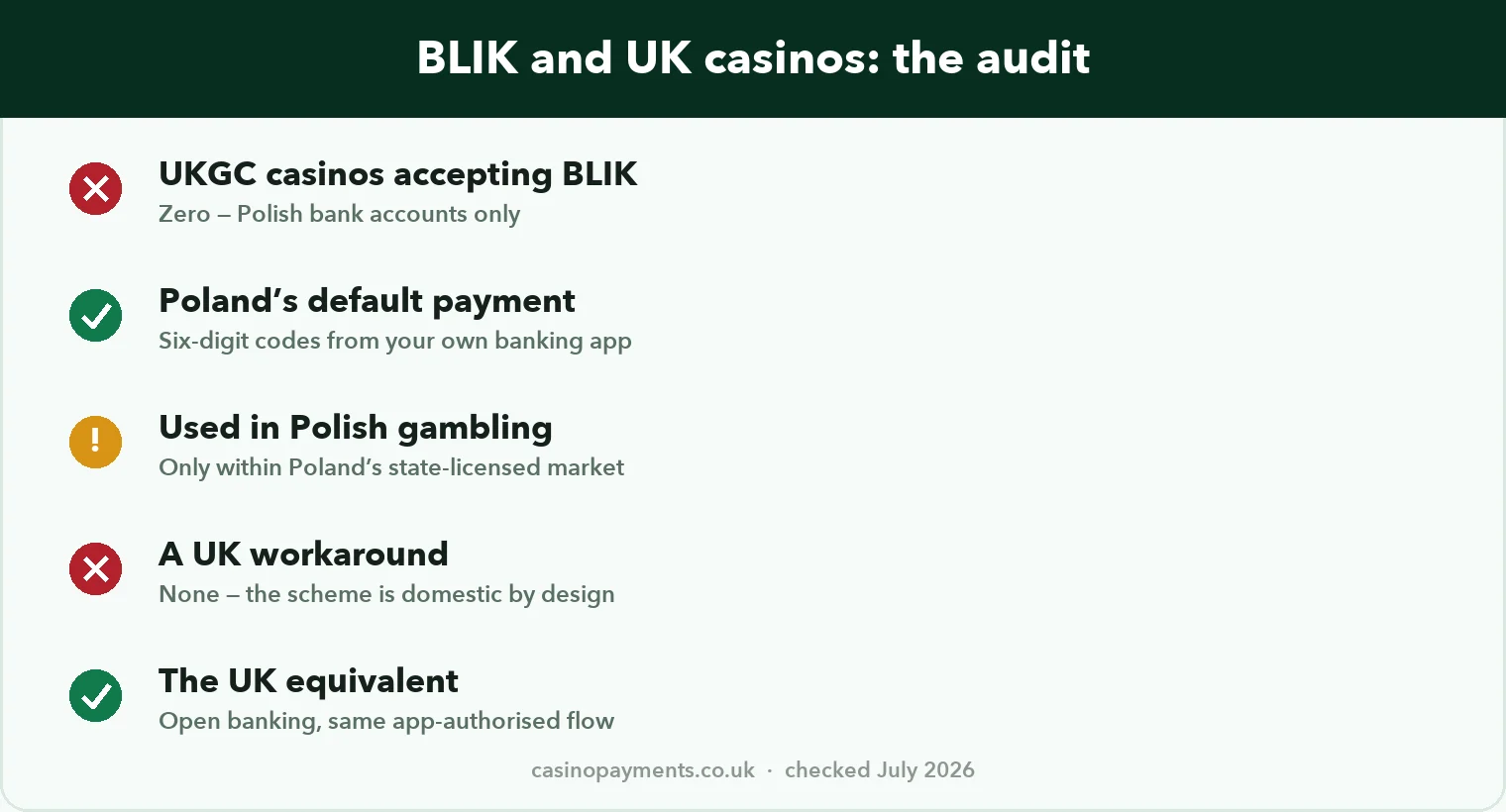
| UKGC acceptance | None — Polish bank accounts only |
| The mechanism | A six-digit code from your banking app, valid ~2 minutes, one use |
| Owner | Polski Standard Płatności, owned by Poland’s major banks |
| Poland’s casino market | State monopoly — only Total Casino is licensed online |
| UK equivalent | Open banking — in-app authorisation, no card |
Position checked 24 July 2026 — and unchanged by anything a UK player can do.
| Question | Answer |
|---|---|
| Can UK players use BLIK? | No — it needs a Polish bank account and a Polish banking app |
| What is it, exactly? | A six-digit code from your banking app, valid for two minutes, that authorises one payment |
| How big is it in Poland? | The default — billions of transactions a year, ahead of cards online |
| Polish casinos? | Poland’s online casino market is a state monopoly — only Total Casino is legal |
| The UK equivalent? | Open banking — the same in-app authorisation, different mechanism |
Checked 24 July 2026 · 18+ · UKGC context · begambleaware.org
BLIK: Quick Facts
| What it is | One-time six-digit codes generated in Polish banking apps, authorising a single payment |
|---|---|
| Launched | 2015 |
| Owner | Polski Standard Płatności — a consortium of Poland’s major banks |
| Scale | Billions of transactions annually; the leading online payment method in Poland |
| Requirement | A Polish bank account with a participating bank |
| Uses | Online checkout, in-store contactless, ATM withdrawal without a card, phone-number transfers |
| Poland’s online casinos | State monopoly — Total Casino only |
| UKGC acceptance | Zero |
| UK counterpart | Open banking |
The Six-Digit Design
Most payment innovation asks you to install something, register somewhere or carry a new credential. BLIK asks you to read a number off a screen you already have open.
The flow is genuinely minimal. At checkout you choose BLIK. In your banking app you tap a button and a six-digit code appears, valid for about two minutes and usable exactly once. You type it into the merchant’s field, then confirm the payment in your banking app with your usual authentication. Money moves account-to-account immediately.
Two consequences make this cleverer than it first appears. There is nothing persistent to steal — no card number, no account details, no stored token that retains value after the transaction; a code that has expired or been used is worthless. And it works anywhere you can type digits, which is why the same system covers online checkouts, physical shop terminals and cardless ATM withdrawals without needing three different products.
The trade-off is that BLIK requires the merchant to have integrated it, and the customer to bank in Poland. It is a national standard rather than a portable technology — brilliant inside its borders and meaningless outside them.
Poland’s Casino Monopoly — the Real Story Here
Most regional payment pages on this site follow the same shape: a method works in its home market’s licensed casinos, and UK players simply cannot reach it. Poland breaks that pattern, because Poland’s online casino market barely exists.
Under the Polish Gambling Act as amended in 2017, online casino games are a state monopoly operated through Total Casino, run by the state-owned Totalizator Sportowy. Private operators may be licensed for sports betting, but not for online casino play. The state also maintains a register of blocked domains and requires payment blocking of unlicensed gambling sites — enforcement with genuine teeth.
So “BLIK casinos” in the Polish sense means, for casino games, essentially one legal venue. Everything else marketed to Polish players with BLIK acceptance is operating outside that framework — which is precisely the kind of site the domain-blocking regime targets.
The relevance to a British reader is a warning about the search result rather than the payment. A page advertising “BLIK casinos” is either describing Poland’s single legal operator, or describing sites that are unlicensed in Poland and unlicensed here. Neither is available to you, and the second is the reason to keep walking.
BLIK vs What UK Players Have
Different mechanism, same underlying idea: your bank authorises, no card is involved.
| BLIK | UK open banking | UK debit card | |
|---|---|---|---|
| Available to UK players | No | Yes | Yes |
| What you handle | A six-digit code | An in-app approval | Card details |
| Persistent credential | None | None | Yes — the card number |
| Speed | Instant | Instant | Instant in, variable out |
| Also works at ATMs | Yes — cardless withdrawals | No | Yes, with the card |
| Reversibility | None — instant is final | None | Chargeback possible |
The row British players should note is the last one. Card payments carry chargeback rights; instant bank payments — BLIK, open banking, Faster Payments — do not. That is a fair trade for speed at a licensed operator you chose, and a poor one anywhere else.
How BLIK Works — Where It Works
The four contexts
- Online checkout — generate a code, type it, confirm in the app.
- In-store — the same code typed into the card terminal, no card present.
- ATM — withdraw cash by entering a code, with no card in the machine at all.
- Person-to-person — send money to a phone number, settling instantly.
Why the code approach persisted
BLIK launched in 2015, before app-to-app redirection was smooth on most phones. Typing six digits was more reliable than bouncing between applications, and it worked identically on desktop, mobile web, physical terminals and cash machines. That universality is why it stuck even as redirect flows improved elsewhere — one mechanism covering every payment context is worth more than a slicker flow covering one.
The equivalent UK sequence
- Choose Pay by Bank at a UKGC-licensed cashier instead of entering card details.
- Pick your bank; the flow redirects to your own banking app rather than asking for a code.
- Authorise the exact amount with your usual biometrics or passcode.
- Funds move instantly account-to-account, and payouts come back the same way on Faster Payments.
Why no UK player can use it
The code is generated by a Polish bank’s app for a Polish bank account. There is no registration route, no international version and no workaround, because the requirement is a banking relationship rather than a location. As with Spain’s Bizum, this is a closed door rather than a barrier — and Poland’s casino monopoly means there is very little on the other side of it anyway.
How BLIK’s Six-Digit Code Model Protects You
BLIK’s architecture is unusually resistant to the standard payment attacks. There is no card number to skim, no stored credential to breach, and no reusable token — a code is single-use, expires in around two minutes, and is confirmed separately inside the banking app under strong customer authentication. Even a code intercepted in transit is close to worthless by the time anyone acts on it.
The residual risk is behavioural, and Polish banks warn about it constantly: social engineering. Because the system is so simple, the entire attack surface reduces to persuading someone to generate a code and read it out, or to confirm a payment they did not initiate. Fake marketplace buyers, bogus “refund” calls and cloned checkout pages all work this way. And as with every instant payment scheme, an authorised transfer is irreversible — there is no chargeback to fall back on.
The British lesson is the same one that follows every fast-rail page on this site: with cards you have a dispute route; with instant bank payments you have none. Initiate payments yourself, at places you chose, and treat any request that arrives unsolicited as an attack regardless of how plausible the story sounds.
From Bank Consortium to National Default
- 2015 — BLIK launches, built by Polski Standard Płatności, a joint venture of Poland’s largest banks.
- 2016 — Cardless ATM withdrawals and in-store payments extend the code beyond e-commerce.
- 2017 — Poland’s gambling law is amended, confirming the online casino monopoly and introducing domain and payment blocking.
- 2018–2019 — Adoption accelerates as more banks join and e-commerce grows.
- 2020 — Pandemic contactless preference and online shopping drive a step change in volume.
- 2021–2022 — BLIK overtakes cards for Polish online payments; transaction counts reach the billions.
- 2023–2024 — International ambitions emerge, including acquisitions aimed at extending the model beyond Poland.
- 2026 — Still overwhelmingly domestic, still unavailable to anyone banking outside Poland.
The pattern matches Bizum’s exactly, and both point at the same conclusion: bank-owned payment schemes achieve adoption independent fintechs cannot, because distribution is solved before launch. Britain chose a regulated framework with competing providers instead — more competition, less brand recognition, identical capability.
What BLIK Handles Across Poland
BLIK’s significance in Poland is hard to overstate: it is how people pay online, how they send money to friends, how many of them withdraw cash, and increasingly how they pay in shops. For a payment scheme launched in 2015 to overtake cards for e-commerce in under a decade is a genuinely remarkable outcome, and it happened because the banks that would otherwise have competed built one thing together.
The wider European story is the interesting one. BLIK, Bizum, the Nordic apps and the Wero initiative all represent domestic or regional alternatives to the American card networks, and several have begun exploring interoperability. Britain sits outside those conversations post-Brexit, reaching instant bank payments through open banking’s regulated-competition model instead. Both routes work; they simply produce different market shapes — one with famous consumer brands, one with invisible infrastructure.
Safer Gambling Controls Around BLIK
There is no BLIK deposit available to a UK player, so the practical warning concerns where the search leads. Any site offering BLIK to a British visitor is outside the UKGC perimeter — and given Poland’s casino monopoly, quite likely outside Poland’s too. That means no GAMSTOP, no ADR route, no funds-protection rating, no affordability checks, and an operator answering to nobody a British player can contact.
The transferable point is about instant bank payments generally, since Britain has its own. They are fast, final and frictionless — excellent properties for a planned deposit, unhelpful ones at 2am. Set cashier deposit limits before playing, arm your bank’s gambling block if control is part of your picture, and use GAMSTOP for exclusion that follows the person rather than the payment method. The full stack sits in our responsible gambling hub, and the National Gambling Helpline is free and confidential on 0808 8020 133, any hour. 18+.
What Polish Players Say
Polish discussion of BLIK is overwhelmingly about ordinary life rather than gambling — and the tone is proprietorial in a way British payment discussion never is. People genuinely like it, cite it as something Poland does better than most countries, and find card checkout clunky by comparison. Its ubiquity has made the six-digit code a small cultural artefact.
Gambling-specific commentary is muted, for the structural reason this page explains: with online casino games confined to a single state operator, there is no competitive market to compare payment experiences across. Discussion that does exist tends toward the legal status of offshore sites and the blocking regime, rather than which cashier pays fastest.
The recurring warning genre is fraud, and it mirrors Spain’s: scams built on persuading someone to generate a code or approve a payment they did not start. The mechanism’s simplicity is its own attack surface. For British readers the lesson generalises cleanly to open banking — the technology is safe, the irreversibility is real, and the weak point is always the human being asked to authorise something.
The UK Alternatives
BLIK’s capabilities are available to British players under different names:
- Open banking — the direct equivalent for casino deposits: instant, bank-authorised, no card details, near-universal at UK cashiers.
- Trustly and Volt — the FCA-authorised providers running those buttons.
- Apple Pay / Google Pay — phone-authorised payments on card rails, with chargeback rights BLIK-style payments lack.
- Debit cards — universal, and the only route on this list that keeps dispute rights.
It is worth adding what a British player gains in exchange for the missing six-digit code, because the trade is not one-sided. Open banking’s redirect model — bouncing into your banking app and back — requires no code to read, mistype or misplace, and it works identically whether you are on a phone, a tablet or a desktop. Biometric approval inside the banking app is arguably a stronger authentication step than typing digits from a screen, since nothing transferable ever exists outside the app. BLIK’s design was a brilliant answer to 2015’s constraints, when app-switching was clumsy and unreliable; the redirect model became viable later and is what most of Europe, Britain included, ended up building on.
The one BLIK feature Britain genuinely lacks is cardless ATM withdrawal by code — a nice piece of engineering, and entirely irrelevant to a casino cashier.
What Poland’s Monopoly Actually Teaches
Poland’s approach to online casino regulation is the strictest covered anywhere on this site, and it makes a useful comparison for British readers who occasionally encounter the argument that the UKGC is heavy-handed.
Britain licenses many private operators and regulates their conduct: identity checks, affordability assessments, advertising rules, funds protection, a self-exclusion register and an ombudsman route. Poland permits precisely one online casino operator — the state’s own — and blocks the domains of everyone else, with payment blocking as a backstop.
Both models chase the same objective from opposite directions. Britain’s bet is that a well-regulated competitive market channels demand toward supervised operators, using licensing conditions to protect players. Poland’s bet is that restricting supply to a single accountable operator does it better.
The evidence is genuinely mixed, and it would be dishonest to pretend otherwise. Britain’s model produces a large legal market with real protections and a persistent offshore fringe. Poland’s produces less legal supply, and a documented offshore problem that domain-blocking has reduced rather than solved — because demand does not disappear when licences do.
The transferable point for a British player is about the offshore fringe, which exists under both regimes. Whether your regulator licenses fifty operators or one, the sites outside that perimeter offer the same deal: no self-exclusion reach, no dispute route, no funds protection. The perimeter is what protects you, not its size — which is why this site keeps returning to the licence rather than the payment method.
Our Verdict on BLIK for UK Players
BLIK is the most elegant payment design covered on this site: one six-digit code replacing cards, account numbers and app-switching across four completely different payment contexts, adopted so thoroughly it overtook cards for Polish online shopping within a decade. As a piece of national infrastructure it deserves its reputation.
For a UK player it is doubly closed. The mechanism requires a Polish bank account with no route in, and Poland’s online casino monopoly means even Polish players have exactly one legal casino to use it at. There is nothing to work around and, unusually for these pages, not much on the other side worth reaching.
What British players have instead is open banking — same instant bank-to-bank payment, same in-app authorisation, no card details shared, offered by FCA-authorised providers across the great majority of UK cashiers. You lose the six-digit party trick and keep everything that matters. And if you encounter “BLIK casinos” marketed to a UK audience, that page has told you it is operating outside two countries’ licensing regimes at once.
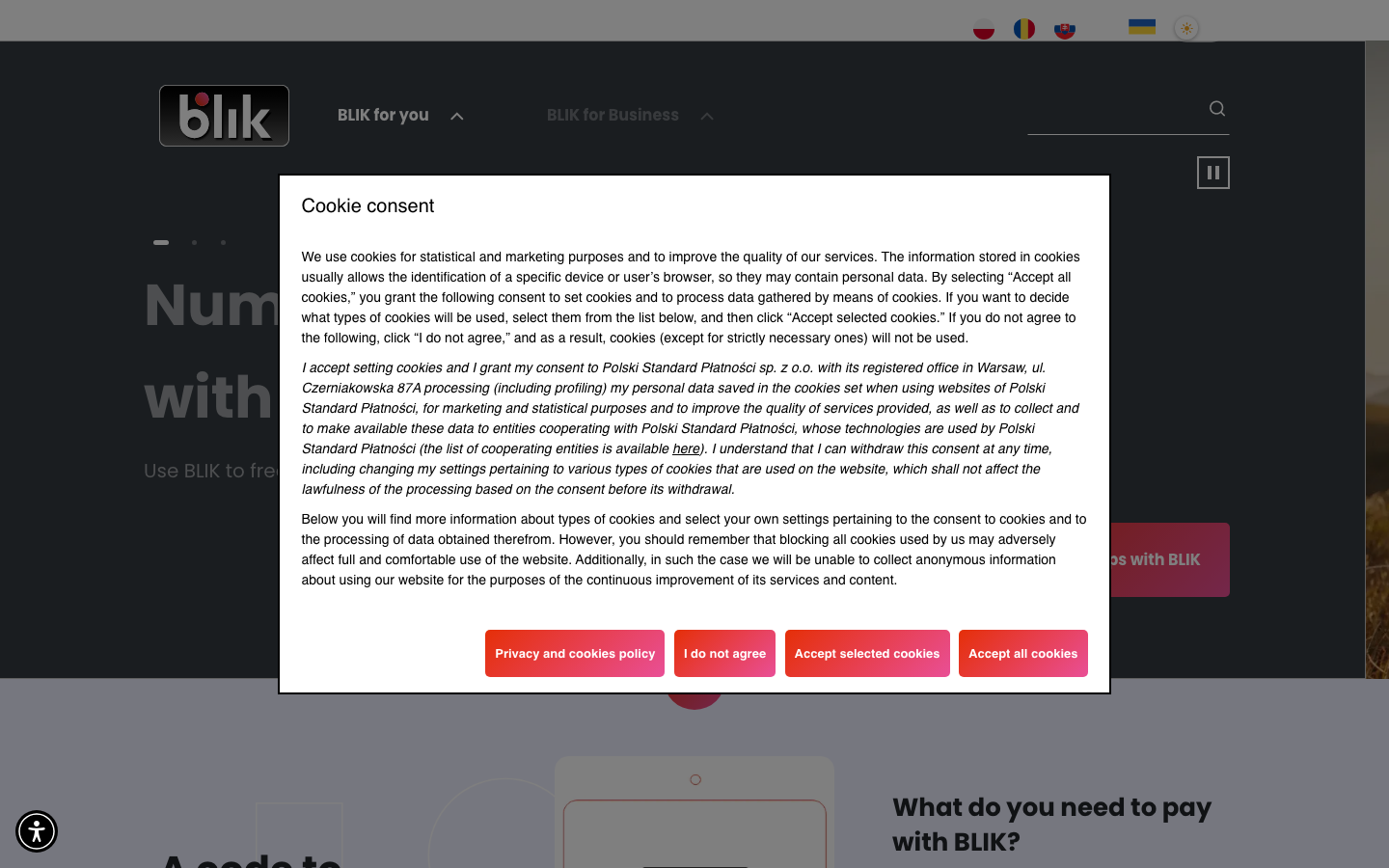
BLIK’s own site, checked directly this month, presents the system exactly as Poles experience it — a payment standard reached from inside the banking apps of the country’s major institutions, with a one-time code as the only thing the user handles. Like Spain’s Bizum, the ownership explains the ubiquity: Polski Standard Płatności is a joint venture of Poland’s largest banks, so the service arrived pre-installed in the apps of most of the banked population rather than needing to win them one at a time.
BLIK Casino FAQs
Can I use BLIK at UK casinos?
No. BLIK codes are generated inside Polish banking apps for Polish bank accounts, so no UKGC-licensed casino can offer it and no workaround exists for a UK-banked player.
What is a BLIK code?
A six-digit number generated in your Polish banking app, valid for roughly two minutes and usable once. You type it wherever you are paying, then confirm the payment in the app.
Are there legal online casinos in Poland?
For casino games, essentially one: Total Casino, run by the state-owned Totalizator Sportowy. Poland’s 2017 gambling law made online casino a state monopoly, with domain and payment blocking of unlicensed sites.
Why can’t a VPN give me BLIK?
Because the requirement is a Polish bank account, not a Polish IP address. The code comes from your bank’s app; if your bank is British, there is no code to generate.
What is the UK equivalent of BLIK?
Open banking — offered as “Pay by Bank” at most UKGC casinos. Instant, account-to-account, authorised inside your own banking app, with no card details shared.
Is BLIK secure?
Very — single-use codes that expire in about two minutes, confirmed separately in the banking app, with no card number or stored credential to steal. The real risk is social engineering, since an authorised instant payment cannot be reversed.
Can I get a chargeback on a BLIK payment?
No. Like all instant bank payments — including UK open banking — transfers are final. Card payments are the route that retains dispute and chargeback rights.
Does BLIK work outside Poland?
Barely. It is a domestic scheme, though its operator has pursued international expansion. For practical purposes it is Polish bank accounts only.
I found a “BLIK casino” accepting UK players — is it safe?
No. It cannot be UKGC-licensed, and given Poland’s monopoly it is very likely unlicensed there too — a site operating outside two regulatory regimes simultaneously.
Can I use BLIK at ATMs?
In Poland, yes — cardless cash withdrawal by entering a code at the machine is one of its four uses, alongside online checkout, in-store payment and person-to-person transfers. It is the one BLIK feature UK open banking has no equivalent for.
How long is a BLIK code valid?
Roughly two minutes, and it can be used once. That short window is central to the security model — an intercepted code is close to worthless by the time anyone could act on it.
Is Poland’s casino monopoly actually enforced?
Yes, with domain blocking and payment blocking of unlicensed gambling sites. Enforcement has reduced rather than eliminated offshore play — demand does not disappear when licences do, which is the same lesson the UK’s offshore fringe teaches.
Why is BLIK so popular in Poland?
Because Poland’s major banks built it jointly, so it arrived pre-installed in most people’s banking apps rather than needing to win users one at a time — the same structural advantage that made Spain’s Bizum ubiquitous.
Sources & Verification
Checked 24 July 2026 against: BLIK’s own site (captured by screenshot the same day) and Polski Standard Płatności’s published documentation on the code mechanism and bank participation; Poland’s Ministry of Finance materials on the Gambling Act’s online casino monopoly, licensing and domain-blocking regime; documented BLIK history; the Gambling Commission’s payment-blocking guidance; and live UKGC operator cashiers confirming zero BLIK availability on the date above.
