
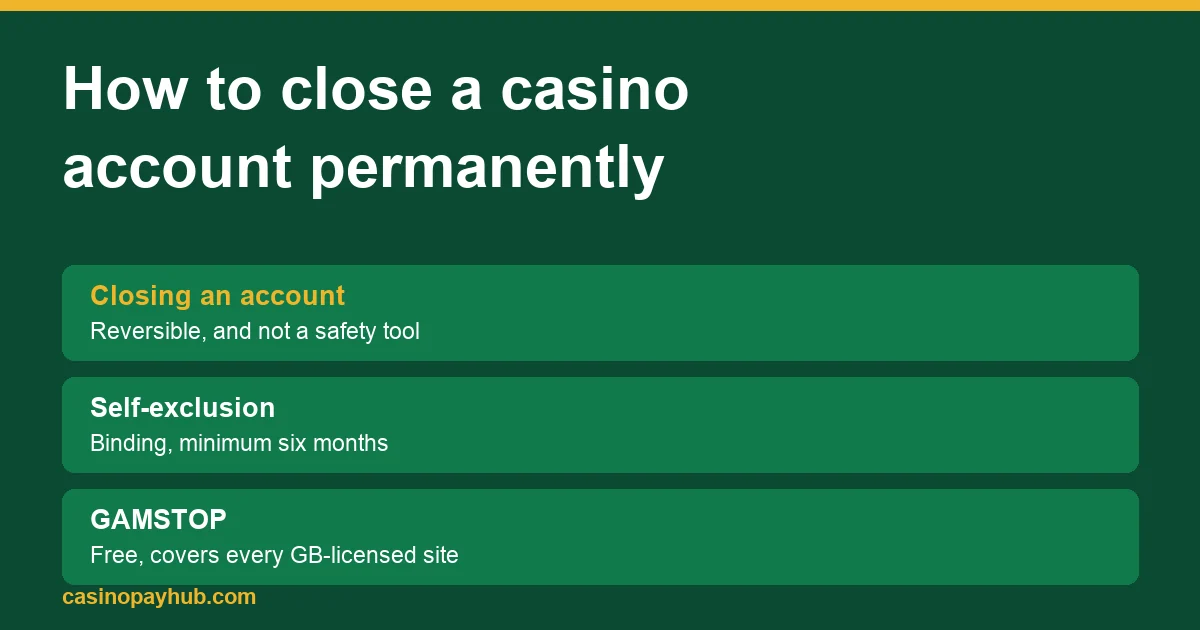
There are three different things people mean by “close my account”, and picking the wrong one is why so many people end up back on the same site a month later.
Closing an account is an administrative request and you can usually undo it. Self-exclusion is a binding commitment with a minimum term that the operator cannot quietly reverse. GAMSTOP does the same thing across every site licensed in Great Britain at once.
This guide explains which one you actually want, how to do it, what happens to money still in the account, and the gaps that catch people out.
The three options, compared
| Option | How binding | Covers | Best for |
|---|---|---|---|
| Close account | Reversible on request | One operator | You are simply finished with a site |
| Time-out | Fixed short period, cannot be lifted early | One operator | A short break, days to weeks |
| Self-exclusion | Binding, minimum six months | One operator, and its sister brands | Gambling has become a problem on that site |
| GAMSTOP | Binding, minimum six months | Every GB-licensed site | You want it to stop everywhere at once |
The distinction that matters: closing an account is not a safety tool. If the reason you want the account gone is that you cannot stop, closing it is the weakest of the four, because you can ask for it back on any given evening.
How to close an account
The mechanics are the same almost everywhere:
- Withdraw your balance first. Closure with money still in the account creates avoidable work.
- Use the account settings menu. Most operators have a close-account option under responsible gambling or account settings.
- Follow up in writing. Email support and ask for written confirmation that the account is closed and the date it happened.
- Unsubscribe from marketing separately. This is often a different setting, and it is the reason “closed” accounts keep emailing people.
- Keep the confirmation. It is your evidence if the account reopens or the emails continue.
If the balance is stuck rather than withdrawable, work through withdrawal declined and why is my withdrawal pending before you close anything. A closed account makes chasing money harder, not easier.
How self-exclusion differs
Self-exclusion is a formal request under the operator’s licence conditions. Once it is in place the operator must close your account for the chosen period, must not send you marketing, and must take reasonable steps to stop you opening a new one. The minimum period is six months.
It also extends further than people expect: a self-exclusion applies across the operator’s other brands on the same licence, which is why knowing who runs a site matters. That point is explained in can you have two casino accounts.
GAMSTOP is the wider version. One free registration blocks you from every site licensed in Great Britain for six months, one year or five years. It cannot be cancelled early, which is the entire point of it.
What happens to your balance
Money in the account should be returned to you. Self-exclusion is not a forfeiture, and an operator should pay out a genuine balance rather than treat it as abandoned. The detail, including what happens with pending bets and bonus funds, is in what happens to your casino balance if you self-exclude.
Expect the payout to follow the normal rules, which means it usually returns by the method you deposited with. That constraint is covered in closed-loop withdrawals, and realistic timings are in how long casino withdrawals take.
The gaps people fall through
| Gap | What happens | What to do |
|---|---|---|
| Sites not licensed in Great Britain | GAMSTOP does not reach them | Add a bank gambling block and a device blocker |
| Marketing emails after closure | A separate setting was never switched off | Unsubscribe explicitly and keep the confirmation |
| A closed account reopened on request | Closure is reversible by design | Use self-exclusion instead if that is the real need |
| Deposits still leaving your bank | The block is on the account, not the money | Turn on your bank’s gambling block: see how gambling blocks work |
| A new account at a sister brand | You may not realise it is the same operator | Check the operator name in the site footer |
The strongest setup is layered, because each layer covers a different failure. GAMSTOP handles the licensed sites. A bank gambling block handles the money. A device blocker handles the impulse at the moment it happens. Any one of them alone has a hole in it.
And if the underlying issue is the gambling rather than the website, free and confidential support is available from GamCare’s National Gambling Helpline. Asking for it early is the single change that helps most.
Closing a Casino Account FAQs
Is closing a casino account permanent?
Not usually. Closure is an administrative request and most operators will reopen the account if you ask. If you need something binding, use self-exclusion or GAMSTOP.
What is the difference between closing an account and self-exclusion?
Closing is reversible and covers one site. Self-exclusion is binding for a minimum of six months, stops marketing, and extends across the operator’s other brands on the same licence.
Does GAMSTOP cover every casino?
It covers every site licensed in Great Britain. Sites operating outside that licence are not covered, which is why a bank gambling block is worth adding.
Do I get my balance back if I self-exclude?
Yes. A genuine balance should be returned to you, normally by the method you deposited with.
Can I cancel a self-exclusion early?
No. The minimum term cannot be lifted early, and that is deliberate.
Why am I still getting emails from a closed account?
Marketing preferences are often a separate setting from account status. Unsubscribe explicitly and keep the confirmation.
Will closing my account stop payments leaving my bank?
No. Closing an account does not touch your bank. A bank gambling block is the tool for that.
Sources & Verification
- Gambling Commission, licence conditions and codes of practice — verifies self-exclusion obligations on licensed operators
- GAMSTOP — verifies the free national self-exclusion scheme and its six-month, one-year and five-year terms
- Gambling Commission, how to complain — verifies the operator-then-ADR escalation route
- GamCare — verifies the National Gambling Helpline and free support services
- Financial Ombudsman Service, gambling-related harm complaints — verifies where bank conduct can be escalated
