

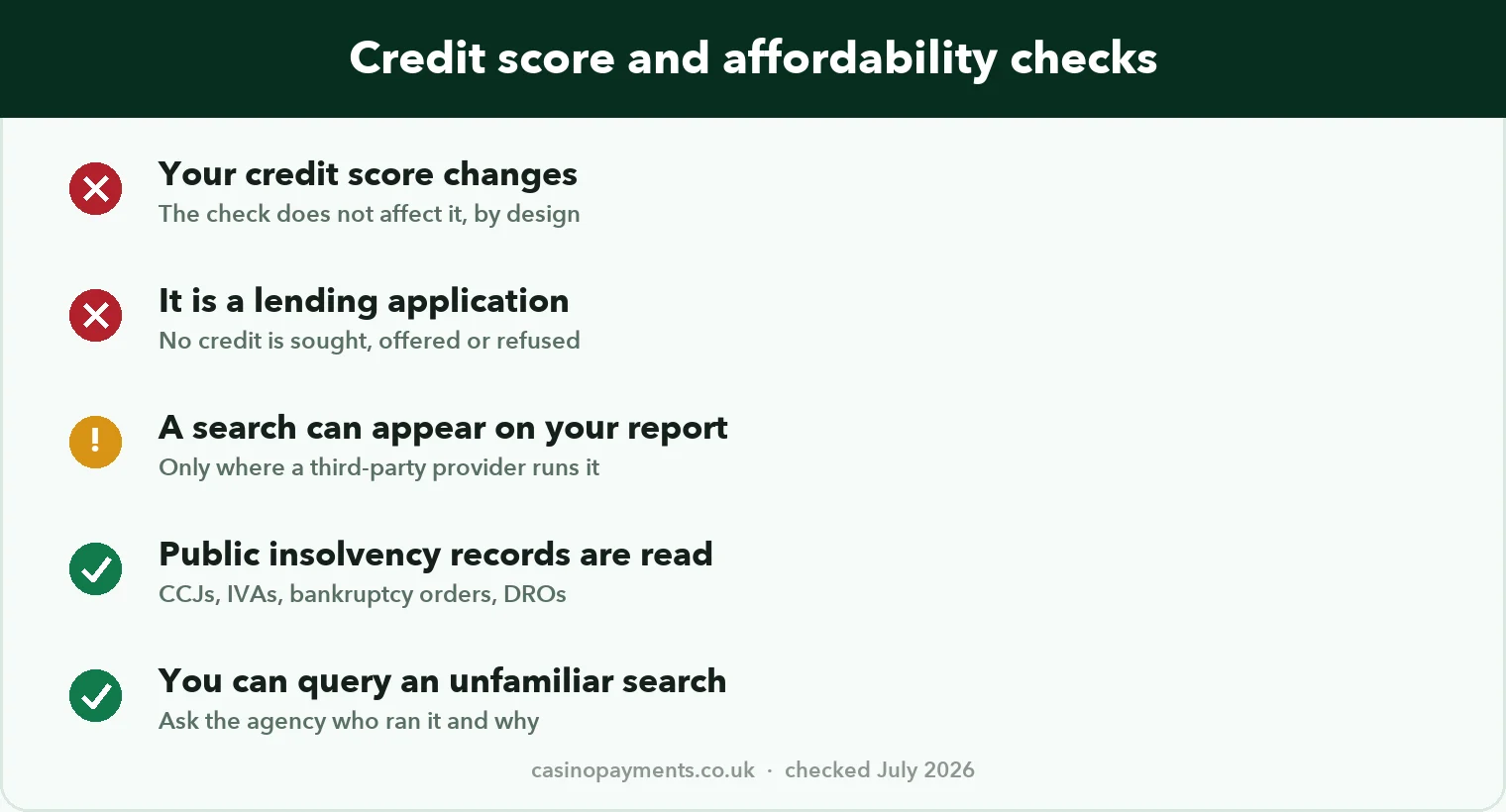
This is the question that generates more worry than any other part of UK gambling regulation, and it has a short answer: no. The Gambling Commission states directly that these checks do not affect a customer’s credit score. That is not a reassuring gloss, it is a design requirement. What confuses people is a separate and genuinely real thing: under some circumstances a record that a search happened can appear on your credit report. A search appearing is not a score changing, and the gap between those two facts is where most of the anxiety lives.
The Short Answer
A light-touch financial vulnerability check does not affect your credit score. It is not a credit application, no lender is deciding anything about you, and nothing about the check makes borrowing more expensive or harder to obtain.
The longer answer is worth reading anyway, because the reason people ask is usually that they have seen something on a credit report and drawn a conclusion from it.
Why It Cannot Affect Your Score
Credit scores move on borrowing behaviour: how much credit you hold, how reliably you repay it, how much of your available limit you use, and how often you apply for more. A gambling operator running a check is doing none of those things. It is not extending credit, not assessing you for credit, and not reporting an account to anyone.
There is also a hard regulatory reason. Credit-funded gambling has been prohibited in Britain since the credit card ban took effect in April 2020. A system designed to spot financial difficulty could hardly be built so that using it made your credit standing worse.
Why a Search Can Still Show on Your Report
Here is the nuance that causes the alarm. Where an operator runs its check through a third-party provider rather than directly, a record that a search took place can appear on your credit report. You may see the name of a company you have never dealt with, on a date you did not expect.
That record is not a mark against you. It does not change your score, it is not visible to lenders as a negative, and it is not evidence of an application. The Commission has encouraged providers to describe these searches accurately precisely because an unexplained company name on a credit report is unnerving, and people reasonably assume the worst.
Soft Searches, Plainly
| What it does | Effect on your score | |
|---|---|---|
| Hard search | Recorded when you apply for credit; visible to other lenders | Can lower it, especially several in a short period |
| Soft search | A look-up that is not an application; visible only to you | None |
| Affordability check | Public insolvency records; may leave a soft-search style record | None |
If you have ever used an eligibility checker before applying for a card, you have already generated the harmless kind of record. The gambling check sits in the same category.
What the Check Actually Reads
Narrower than almost anyone assumes. Publicly available insolvency records only: a bankruptcy order or equivalent, a county court judgment, an individual voluntary arrangement, a high court judgment, an administration order, or a debt relief order.
Your income is not in that list. Your account balances are not. Your overdraft is not, which is why the widespread claim that these checks reveal overdraft-funded gambling is simply untrue. Postcode and job-title data were considered and explicitly rejected after consultation, on the view that guessing at someone’s means from where they live or what they do is exactly the profiling players objected to. The full picture is in our guide to how affordability checks work.
If You See a Search You Do Not Recognise
- Check which agency holds it. Experian, Equifax and TransUnion each hold separate files, and a search on one may not appear on another.
- Look at the search type. Reports label soft searches separately and state plainly that they are visible only to you.
- Ask the agency who ran it and why. You are entitled to know, and they will tell you.
- Do not assume gambling. Insurance quotes, identity checks, employment screening and eligibility tools all generate similar records.
- If it is genuinely unexplained, treat it as a possible identity issue and raise it with the agency rather than ignoring it.
What Does Move Your Score
Worth stating, because the honest risk to your credit standing from gambling is real but sits elsewhere. Missed payments on borrowing damage a score. Persistent overdraft use is visible to lenders reading your statements even when it does not directly score against you, which is covered in our guide on gambling with an overdraft. And gambling transactions on a bank statement are read line by line by mortgage underwriters regardless of what any score says, which is a separate and more consequential exposure than a soft search ever was.
Verdict
No, affordability checks do not affect your credit score, and the regulator says so in terms. If you have found an unfamiliar search on your report, it is worth understanding rather than worrying about: soft searches are visible only to you, carry no weight with lenders, and change nothing about what you can borrow.
If the reason you went looking at your credit report was a worry about how much you are gambling rather than about the check itself, that is the more useful thing to act on. BeGambleAware and the National Gambling Helpline on 0808 8020 133 are free and confidential, and our responsible gambling page covers the payment-level blocks that stop a deposit before it happens.
Credit Score and Affordability Check FAQs
Do casino affordability checks affect your credit score?
No. The Gambling Commission states directly that these checks do not affect a customer’s credit score. The check is not a credit application and no lender is assessing you.
Why can I see a search from a company I do not recognise?
Where an operator runs the check through a third-party provider, a record that a search took place can appear on your credit report under that provider’s name. It does not change your score and it is not an application for credit.
Is it a hard search or a soft search?
It behaves like a soft search: visible to you on your own report, not treated as an application, and carrying no weight with lenders. Hard searches are recorded when you actually apply for credit.
Will a lender see that a casino checked me?
A soft-search style record is visible only to you, not to lenders assessing a future application. What lenders do read closely is your bank statements, where gambling transactions are visible regardless of any score.
What data does the check look at?
Publicly available insolvency records only: bankruptcy orders, county court judgments, IVAs, high court judgments, administration orders and debt relief orders. Not income, not balances, not overdraft use.
Can I stop a casino running the check?
Not while continuing to play at a UK-licensed operator, since the check is a regulatory requirement rather than an optional extra. You can, however, keep your net deposits below the threshold that triggers it.
Does the check show up if I apply for a mortgage?
The search record itself is not visible to a lender. Your bank statements are, and mortgage underwriters read them line by line, so gambling transactions are the real exposure rather than the check.
How long does the record stay on my credit report?
Search records are typically retained for around twelve months by the credit reference agencies, and your report will state the date. It has no effect on your score for that period or afterwards.
Sources & verification: checked 25 July 2026 against the Gambling Commission’s published position on light-touch financial vulnerability checks, which states that the checks do not affect a customer’s credit score, sets out the public insolvency records used, and notes that a check run through a third-party provider may appear on a credit report. See gamblingcommission.gov.uk. 18+ · begambleaware.org
