
Ethereum gave crypto gambling its most seductive argument: code as croupier. If a smart contract pays winners automatically and anyone can audit the odds, who needs a regulator? Britain’s answer has been consistent since the chain launched in 2015 — every UKGC cashier remains closed to ETH — and the reasons say something worth hearing about what a licence actually protects, which was never the fairness of the dice.
For the wider UK position on digital-currency gambling, start with our cryptocurrency casino guide; this page focuses on Ethereum’s network mechanics and asset-specific risks.
Why Ethereum Isn’t a UK Casino Option




| Ethereum & UK Casinos at a Glance | |
|---|---|
| UKGC acceptance | Zero — identical to every other cryptocurrency |
| The famous pitch | "Provably fair" smart-contract gambling — real tech, wrong problem |
| What the licence protects | Identity, affordability, disputes, funds — none of which a contract audits |
| Since the Merge | Proof-of-stake ETH (Sept 2022) cut energy ~99.95% — and changed no regulator's mind |
| Legal path for holders | Swap to GBP on-exchange; deposit by any rated method |
Confirmed 10 July 2026: UKGC operators accepting Ethereum — none, matching every previous check.

| Hoping for | Getting |
|---|---|
| A UKGC casino that takes ETH | There isn't one. Ethereum sits behind the same licensing wall as every coin — acceptance among UK operators: none |
| "But smart contracts make it different…" | Technically fascinating, legally identical — programmable pseudonymity is still pseudonymity |
| Casino dapps and on-chain betting? | They exist, they're clever, and using them from Britain buys you the same nothing: no GAMSTOP, no ADR, no recourse |
| Can ETH holders play legally? | Absolutely — swap to sterling on a regulated exchange and every method this site rates is open |
| The experience nearest the hype | Open banking: instant, app-authorised, and the winnings actually arrive protected |
Confirmed 10 July 2026 · 18+ · UKGC context · begambleaware.org
Ethereum: Quick Facts
| Launched | July 2015; proposed by Vitalik Buterin in 2013 |
|---|---|
| What it is | A programmable blockchain — applications (“smart contracts”) run on-chain; ETH fuels them |
| Scale | The second-largest cryptoasset and the dominant smart-contract platform |
| The Merge | September 2022: proof-of-work retired for proof-of-stake, cutting energy use ~99.95% |
| Gambling relevance | Birthplace of on-chain casinos, prediction markets and the “provably fair” movement |
| UKGC acceptance | None — no licensed operator accepts ETH deposits in any form |
| Gas fees | Variable with congestion; layer-2 networks reduce but complicate |
| FCA classification | High-risk cryptoasset — the lose-everything warning applies |
| Legal player route | Sell for sterling; deposit conventionally |

Code as Croupier: The Best Bad Argument in Gambling
Ethereum made possible something genuinely new: a casino game whose entire logic lives in public code. Anyone can read the contract, verify the house edge, confirm the randomness source, and watch payouts execute without human hands. The “provably fair” movement built exactly this, and at its best it works as advertised — the dice really are auditable in ways no Vegas floor manager could offer.
Here is why that magnificent machine changes nothing at a British cashier: game fairness was never the load-bearing protection. Rigged roulette is vanishingly rare in licensed gambling; the harms regulation actually prevents live elsewhere. Is the player eighteen? Is the money theirs, and can they afford its loss? Is a self-excluded person being re-admitted? When the operator and player disagree, who decides — and who compels payment? A smart contract answers none of these; several, it structurally refuses to answer, because collecting identity would betray its design.
So the on-chain casino solves the one problem regulators had largely solved already, while formalising the ones they exist for. That’s not a wall Ethereum failed to climb; it’s a different building. The UKGC licenses accountability — and immutable, permissionless, author-optional code is accountability’s photographic negative, however beautiful the mathematics.
Ethereum vs the Methods That Actually Deposit
The properties, side by side — including the ones ETH genuinely wins, since honesty is this site’s whole product.
| Ethereum | Debit card | Open banking | PayPal | |
|---|---|---|---|---|
| UKGC availability | None | Universal | Near-universal | Very broad |
| Settlement finality | Minutes, irreversible | Reversible rails with dispute machinery — a feature, not a bug | ||
| Value stability | Market-dependent | Sterling throughout | ||
| Auditability of games | On-chain, genuine | Via licensed testing houses (eCOGRA-class), mandated | ||
| Who fixes a wrong? | Nobody is appointed | Operator → ADR → UKGC, in law | ||
Note the auditability row: Britain’s answer to rigged-game risk is mandatory independent testing under licence condition — less elegant than a public contract, but attached to enforcement. The wider category comparison lives in our crypto overview; the sibling coin stories in Bitcoin and Solana rhyme with this one deliberately — the wall is the same wall.
How Ethereum Gambling Operates — Described, Not Recommended
The two offshore species
- Conventional casinos taking ETH: ordinary offshore lobbies where Ethereum is one deposit coin among many — the chain is a funding rail, the games are standard server-side software, and “crypto” is mostly marketing.
- True on-chain dapps: games and prediction markets living as contracts, played wallet-to-contract with no account at all — the philosophically pure form, and the one where every regulatory absence is structural rather than negligent.
The player flow, either way
- Acquire ETH at a regulated exchange (full KYC — the identity check happens here, and only here).
- Transfer to a self-custody wallet or the casino’s address; pay gas, wait for confirmation.
- Play in ETH terms while the pound value of your bankroll floats with the market.
- Withdraw — instantly by design at dapps, at the operator’s discretion elsewhere, minus gas either way.
The parts the pitch omits
Gas fees turn small stakes uneconomic during congestion. Layer-2 networks fix the fees and fragment the experience across bridges — each bridge its own risk. Wallet self-custody means self-inflicted losses are total and unappealable: a mistyped address is a donation. And the smart contract that cannot cheat you also cannot help you — there is no “contact support” in immutable code, which players discover at exactly the moments support exists for.
What Audits Can’t Cover: The Security Section
Grant every technical claim its best case — audited contracts, verified randomness, open source throughout — and tally what remains uncovered. Operator risk: most “Ethereum casinos” are conventional businesses whose games never touch the chain; the audit-shaped hole is filled by trust in an unlicensed counterparty. Contract risk where it is on-chain: audits catch bugs, not intentions — admin keys, pausable functions and upgrade proxies have drained “immutable” protocols before, and gambling dapps are unusually juicy targets. Perimeter risk: the exchange leg, the bridge leg and the wallet itself are where funds actually vanish — phishing, approvals malware and seed-phrase theft dwarf on-chain game losses in the incident record. And the constant: zero UK standing. No GAMSTOP integration, no ADR body, no funds-segregation rules, no regulator to escalate to — the entire British protection stack this site describes on every method page, absent as a matter of architecture.
The honest summary inverts the marketing: Ethereum gambling is trustless precisely where trust was cheap, and trust-demanding precisely where trust was the product being replaced.
From White Paper to World Computer: The Gambling Thread
- 2013 — A nineteen-year-old Vitalik Buterin proposes a blockchain that runs programs, not just payments.
- 2015 — Mainnet launches in July; within months, dice and lottery contracts appear — gambling is again crypto’s first mover.
- 2016 — The DAO hack and contentious fork demonstrate that “code is law” bends when enough money hurts — a lesson gambling dapps inherit.
- 2017 — The ICO boom; prediction markets and casino tokens proliferate, most now archaeological.
- 2020 — DeFi summer industrialises on-chain finance; gambling dapps mature alongside.
- 2022 — The Merge lands in September — proof-of-stake, energy cut ~99.95%, the environmental objection retired overnight. UK cashier count: still zero.
- 2024–2025 — Layer-2 networks carry most user activity; US spot ETH ETFs mainstream the asset.
- 2026 — Ethereum is financial infrastructure with institutional custody — and precisely as absent from UKGC cashiers as at launch.
The Merge entry is this page’s pivot: when the loudest external criticism vanished and acceptance still didn’t move, the real obstacle was confirmed as identity, not electricity.
Ethereum Gambling Worldwide
Ethereum’s gambling geography largely traces Bitcoin’s, with a dapp-shaped addition. The offshore lobby sector clusters under Curaçao-class licences and serves ETH alongside every coin — jurisdiction shopping, not technology preference. The dapp layer is genuinely stateless: a contract deployed to mainnet is everywhere and nowhere, which several regulators have answered by targeting the interfaces — front-end websites and app stores — rather than the unreachable code. Prediction markets live in recurring legal skirmishes on exactly this line. Among serious licensing regimes the convergence holds: the US states, Ontario, and the stricter European markets all field zero crypto cashiers, while Malta-class flexibility remains hedged to the point of rarity. Britain’s zero is therefore ordinary — and for a UK player the practical reading of any ETH-accepting venue is unchanged from our other coin pages: the acceptance itself is the licence disclosure. Somewhere with real oversight would not be offering it.
Ethereum Beyond the Casino Balance
Away from gambling, Ethereum’s decade has been consequential: it hosts the majority of stablecoin circulation (the plumbing of crypto markets), the tokenisation experiments of major asset managers, the NFT wave’s rise and correction, and a developer ecosystem no rival chain matches. Post-Merge proof-of-stake also created something gambling-adjacent in the strictly financial sense — staking yield — which UK holders access through regulated platforms with tax consequences (income, generally) that surprise as reliably as capital gains do. The FCA’s cautious accommodation — registration for exchanges, risk warnings for consumers, no retail derivatives — sketches Britain’s settled posture: hold it, trade it, build on it; just don’t expect it in a cashier. In that sense Ethereum’s mainstream success story and its UK gambling non-story are the same story: the more legitimate the asset became, the clearer it became that legitimacy was never the cashier’s question.
Safer Gambling: The Dapp-Specific Warnings
Everything our Bitcoin page says about offshore crypto play — the GAMSTOP void, the absent affordability checks, the volatility layered under stakes — applies to ETH unchanged. Ethereum adds two hazards of its own. Frictionlessness by design: a dapp has no account to close, no operator to email, no exclusion list to join — self-exclusion isn’t unsupported, it’s unimplementable, making on-chain gambling uniquely hostile to anyone managing their play. Yield-blur: staking, farming and “GambleFi” tokens dress wagering in investment vocabulary, and the line between speculating and staking (the casino sense) is precisely where problem gambling hides from its owner. If either paragraph reads personally, act on the reading: GAMSTOP for the licensed perimeter, Gamban-class device blocking for the unlicensed one (it covers crypto gambling sites), bank blocks for the on-ramps, and the full kit at our responsible gambling hub. The National Gambling Helpline — 0808 8020 133 — is free, confidential and open all hours. 18+.
What Players Report About Ethereum Casino Payouts
The ETH-gambling record has a distinctive intellectual flavour absent from other coins’ threads: long, earnest arguments about whether provable fairness makes regulation obsolete, usually between someone who has read the contracts and someone who has read the aftermaths. The technical posts are often excellent — randomness beacons dissected, house edges verified to the wei — and sit strangely beside the adjacent genre they never quite answer: withdrawal holds at ETH-accepting lobbies whose games were never on-chain at all, gas-fee arithmetic that quietly ate small bankrolls, bridge and wallet drains recounted in the flat tone of large sums. The dapp-native testimonies split cleanly: satisfaction that payouts executed exactly as coded, and the belated discovery that “exactly as coded” is the entire customer-service department. And a recurring UK-specific thread deserves the last word: self-excluded players reporting how invisible on-chain venues were to every tool they’d armed — posted, almost always, as warnings rather than tips. The community’s own archive, read whole, is this page’s argument in first person.
Routes for the ETH Holder Who Fancies a Flutter
The bridge from wallet to licensed cashier is short and entirely conventional:
- Swap and withdraw: ETH to GBP at your FCA-registered exchange, Faster Payments to your bank — often inside an hour end-to-end — then any method on this site. Disposal is a capital-gains event; the taxman does not care that the proceeds bought spins.
- Keep the instant-and-app-based feel: open banking deposits authorise in your banking app and land immediately — the closest licensed experience to a wallet signature.
- Keep the self-custody discipline: a prepaid card or voucher enforces hard bankroll separation the way a dedicated hot wallet was supposed to.
- Keep the speed of exits: push-payment withdrawals deliver winnings in the hour, with an operator and ombudsman attached to every one.
What no bridge carries across is the wish to gamble where no rules reach — and this page’s whole argument is that the rules were the valuable part.
Gas Economics for Gamblers: Losing Twice on Small Stakes
Ethereum’s fee model deserves a gambler-specific translation, because it taxes exactly the play style casual players bring. Gas is priced per computation, not per pound moved — the network charges the same to process a £5 bet as a £5,000 one, and the price floats with congestion. In quiet hours a transaction costs pennies; when the chain is busy — and crypto’s busy hours correlate with exactly the market excitement that brings players in — the same transaction can cost more than a small stake itself. A tenner wagered through a fiver of gas needs to double just to break even with never having played: the house edge of the network, charged before any game begins.
The mitigation the ecosystem offers is layer-2 networks — Arbitrum, Optimism, Base and peers — where fees genuinely collapse to fractions of a penny. The gambling-relevant catch is the bridge: moving funds between mainnet and a layer-2 is its own transaction (with its own fee and delay), each network fragments liquidity and venue support differently, and bridges themselves have been the site of some of crypto’s largest thefts. The player chasing cheap bets across layers is running infrastructure decisions a licensed cashier never asks of anyone.
Contrast, as ever, the boring alternative: a £5 deposit at a UKGC casino costs £5, moves instantly, and the payment layer’s fee to the player is zero at every stake size — economics so unremarkable nobody writes sections about them. That absence of a section is the point of this one.
Five Terms That Decode Every ETH-Casino Pitch
The vocabulary does heavy lifting in this niche; here is what each load-bearing word actually carries. “Provably fair” — the game outcome is verifiable; the operator’s willingness to pay remains exactly as provable as before, which is not at all. “Decentralised” — ranges from genuinely on-chain (no operator, no recourse) to a marketing adjective on a normal offshore site; either way, note what it decentralises away: accountability. “Non-custodial” — your keys, your coins, your unrecoverable mistakes; the phrase describes who can’t help you as much as who can’t cheat you. “Audited” — by whom, of what, when? A contract audit is not an operator audit, and neither is a licence. “Anonymous” — the pitch’s favourite and the regulator’s whole objection in one word; whatever it’s worth to you, notice it’s worth more to the operator, whose obligations dissolve in it. Read any ETH-casino landing page with these translations applied and the pitch usually finishes reading itself out loud.
Our Verdict on Ethereum for UK Casino Players
Ethereum is the most intellectually serious challenge crypto ever posed to gambling regulation, and the verdict is the more instructive for that: it loses on the merits, not the optics. The chain genuinely delivers what it promises — auditable games, automatic payouts, code without discretion — and in doing so illuminates exactly what those properties cannot supply: an identity check, an affordability question, a dispute a human can win, an exclusion that binds. Britain’s licensed system provides precisely that unglamorous list, which is why its cashiers take pounds and not ether, and why nothing since 2015 — not the Merge, not the ETFs, not the finest audit — has moved the count off zero. Hold ETH on its investment case if you hold it at all; when the mood for a licensed flutter strikes, the exchange is your cashier’s front door. The world computer runs many things magnificently. British gambling law, by design, is not among them.
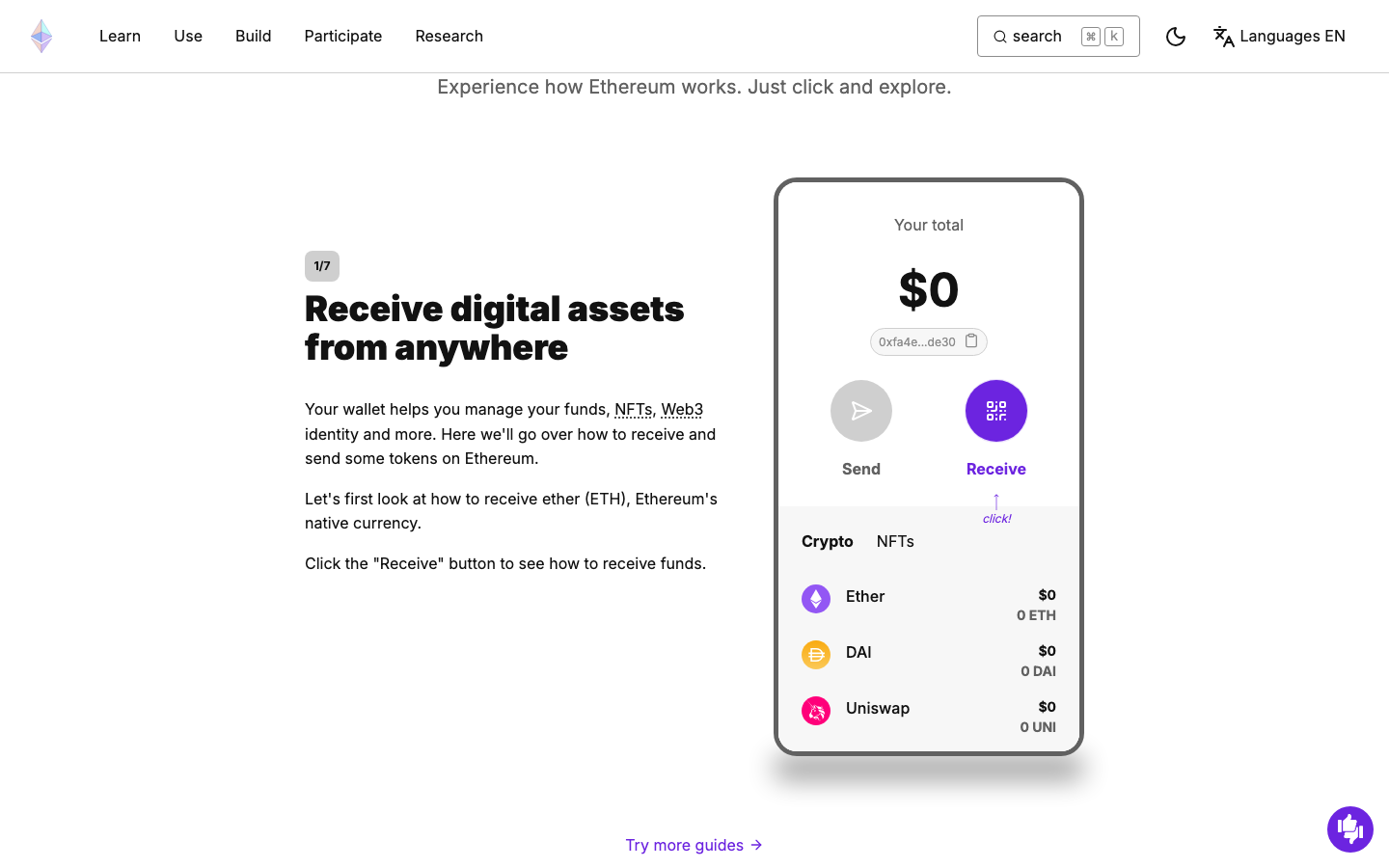
Ethereum.org, checked directly this month, currently walks visitors through an interactive wallet demo — “receive digital assets from anywhere”, ether alongside stablecoins like DAI — under the banner “Experience how Ethereum works. Just click and explore.” The openness is genuine and the engineering real; nothing in the demo, notably, asks who you are — which is precisely the feature UK gambling law cannot license.
Ethereum Casino FAQs
Do any UK casinos accept Ethereum?
No — UKGC acceptance of ETH is zero, as it is for every cryptocurrency. Sites offering ETH play to UK players are unlicensed here, whatever licence badge their footer carries.
Doesn’t “provably fair” make ETH casinos safer than regular ones?
It genuinely verifies game outcomes — but game rigging was never the main risk. Identity, affordability, dispute rights and enforceable payouts are what licences protect, and no contract audit supplies them.
What’s the difference between an ETH casino and a gambling dapp?
Most “ETH casinos” are ordinary offshore sites that accept the coin; their games never touch the chain. Dapps run the games as on-chain contracts — purer technically, and even further from any regulatory protection, since there’s no operator at all.
Can I legally hold Ethereum in the UK and still gamble?
Yes, separately: holding ETH is lawful, and gambling at licensed casinos is lawful — the bridge is selling for GBP on a regulated exchange. UK capital-gains tax applies to the disposal.
Did the Merge change anything for UK gambling?
It cut Ethereum’s energy use by roughly 99.95% and retired the environmental objection — and moved UKGC acceptance not at all, which usefully proved the obstacle was identity and accountability, not electricity.
What are gas fees and do they matter for gambling?
Per-transaction network fees that float with congestion. For small stakes they can rival the stake itself at peak times; layer-2 networks reduce them at the cost of bridge complexity and risk.
Are smart-contract casino audits trustworthy?
Good audits catch bugs; they don’t bind intentions. Admin keys, pausable functions and upgradeable proxies have overridden “immutable” code before — and most player losses happen at wallets, bridges and phishing pages the audit never covered.
Does GAMSTOP block Ethereum gambling sites?
No — GAMSTOP binds UKGC licensees only, and on-chain dapps have no operator to bind. Device-level blockers like Gamban cover crypto gambling sites and are the practical tool for that perimeter.
Is staking ETH a form of gambling?
Legally no — it’s yield on validating the network, taxed as income in the UK. But “GambleFi” products deliberately blur wagering into DeFi vocabulary; if the appeal of a token is the bet inside it, name it to yourself honestly.
Will Ethereum ever reach UK cashiers?
Only behind fully regulated, identity-complete rails — at which point it would be functionally a bank transfer in costume. Nothing in current UK policy points there; plan on the zero.
Are layer-2 networks like Arbitrum or Base any different for gambling?
Cheaper and faster, legally identical — a layer-2 inherits Ethereum’s pseudonymity, so the UK licensing position is unchanged. They also add bridge risk, which has produced some of crypto’s largest losses.
Sources & Verification
Checked 10 July 2026 against: ethereum.org (interactive introduction captured by screenshot the same day); documented Ethereum history including the 2015 launch and September 2022 Merge with its ~99.95% energy reduction; the FCA’s cryptoasset consumer warnings; the Gambling Commission’s LCCP anti-money-laundering framework and payment-blocking guidance; and live UKGC cashier checks confirming zero crypto acceptance on the date above.
