
OXXO Pay lets a Mexican shopper without a bank account pay cash at any of the country’s 21,000-plus OXXO stores, while SPEI moves money instantly between Mexican bank accounts for those who do have one — two complementary rails covering almost the entire population. Neither reaches a UK casino, since both settle exclusively in pesos through Mexican infrastructure. This page covers how OXXO and SPEI work, their role in Mexico’s SEGOB-permitted gambling market, and the UK methods that fill the same two gaps.
Why OXXO Stops at the Mexican Border




| OXXO/SPEI at a Glance | |
|---|---|
| UK casino availability | None — Mexican pesos only |
| SPEI operator | Banco de México (the central bank) |
| OXXO operator | FEMSA, Mexico's largest convenience-store chain |
| Where used | SEGOB-permitted Mexican gambling market |
| UK equivalent | paysafecard (cash) or open banking (instant bank rail) |
Checked 5 July 2026 — and reliably checkable indefinitely, since both methods’ confinement to Mexican infrastructure is structural, not a policy that could shift.
The OXXO casinos that do exist operate in Mexico under SEGOB permits — none holds a UKGC licence, and the same is true of every SPEI cashier.

| Question | The reality |
|---|---|
| Will a UK casino ever take OXXO or SPEI? | Neither is offered — both settle exclusively through Mexican pesos and Mexican banking or retail infrastructure |
| What's the difference between them? | OXXO Pay is cash-at-till, aimed at Mexicans without bank accounts; SPEI is Banxico's instant bank-to-bank rail for those who do have one |
| Are they used for gambling in Mexico? | Yes — SEGOB-permitted Mexican sports-betting and online gambling operators commonly list both as standard deposit methods |
| Could a UK operator add them? | Only by joining Mexican banking and OXXO's own retail settlement network directly, which no UK casino does |
| What's the UK equivalent? | SPEI's instant-transfer idea maps to open banking; OXXO's cash-till model maps to paysafecard |
Neither "OXXO casino UK" nor "SPEI casino UK" has anywhere to go — one is a Mexican convenience-store chain's cash payment system, the other is Mexico's central bank's own instant-transfer rail, and neither has any presence in British banking. What makes this pairing genuinely interesting is how deliberately they complement each other: one method built for Mexicans with a bank account, one built for the roughly two in five Mexican adults who traditionally haven't had one. That split is the story this page tells.
Facts verified 5 July 2026 · 18+ · UKGC-licensed operators only · begambleaware.org
OXXO/SPEI: Quick Facts
| What OXXO Pay is | A cash-voucher payment system run through OXXO, Mexico’s largest convenience-store chain (21,000-plus locations), owned by FEMSA |
|---|---|
| What SPEI is | Banxico’s (Mexico’s central bank) instant interbank electronic payment system, launched 13 August 2004 |
| UK casino availability | Zero for both — neither connects to UK banking or retail infrastructure |
| Who each serves | OXXO Pay: Mexicans without a bank account. SPEI: Mexicans who have one, wanting instant transfers |
| Speed | OXXO Pay confirms by the next business day; SPEI settles in seconds |
| Mexican gambling role | Both are standard deposit methods at SEGOB-permitted Mexican sports-betting and online gambling operators |
| UK equivalents | paysafecard for OXXO’s cash model; open banking for SPEI’s instant-transfer model |
Reading that table left to right, the pattern that jumps out is how cleanly the two Mexican systems divide labour rather than overlap. That’s unusual among the payment methods covered on this site — most countries build one dominant instant-transfer rail and leave cash-based access as an afterthought, whereas Mexico effectively built two purpose-designed systems side by side, each aimed at a distinct segment of the population, and both ended up widely adopted by the country’s SEGOB-permitted gambling operators as a result.
OXXO/SPEI vs Their UK Equivalents
OXXO Pay and SPEI solve two different problems that, between them, cover almost the entire Mexican adult population — a genuinely deliberate design when you consider how the two systems complement rather than compete with each other. UK payments don’t split quite the same way, since the large majority of UK adults hold a bank account, but the underlying mechanics still map cleanly onto existing UK methods.
| OXXO Pay (Mexico) | SPEI (Mexico) | UK equivalent | |
|---|---|---|---|
| Who runs it | OXXO/FEMSA, a private retail chain | Banxico, Mexico’s central bank | N/A — split differently |
| Requires a bank account | No | Yes | — |
| Speed | Confirms next business day | Seconds | — |
| UK match | paysafecard/Neosurf | Open banking | Both widely available at UK cashiers |
The practical upshot: whichever half of the OXXO/SPEI pairing appealed to you, the UK already has a direct match already built into every UKGC-licensed cashier. It’s worth noting, too, that the UK match isn’t a rough approximation forced to fit — open banking genuinely is an instant, bank-authenticated transfer in the same category as SPEI, and paysafecard genuinely is a cash-bought voucher redeemable without a bank account in the same category as OXXO Pay. Nothing about switching from the Mexican system to the British one changes the underlying category of payment a player is using, only the specific rails and currency behind it.
One more distinction worth flagging: SPEI, unlike open banking, isn’t built around a standardised regulatory framework shared across an entire economic bloc the way PSD2 underpins open banking across the EU and UK. SPEI is a single national system run directly by Banxico, which makes it faster to evolve (one institution can update it without cross-border coordination) but also means its reach stops precisely at Mexico’s own banking sector, with no equivalent passporting arrangement to extend it elsewhere.
How OXXO Pay and SPEI Actually Work
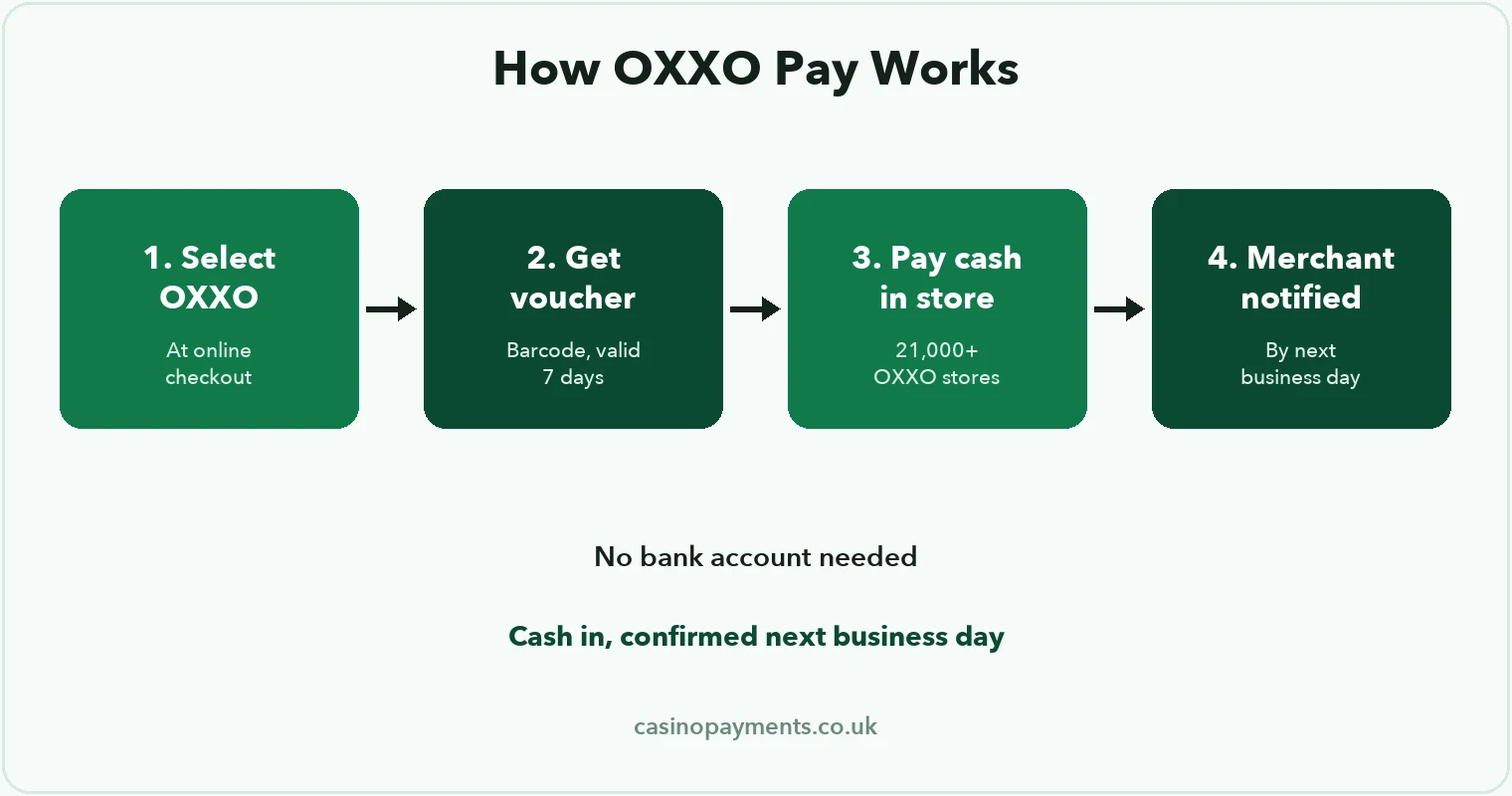
OXXO Pay generates a voucher at checkout — a barcode with the transaction details attached, valid for seven days by default. The customer takes that voucher, printed or on their phone, to any OXXO store and pays the amount in cash at the till. Confirmation back to the merchant typically lands by the next business day, since it routes through OXXO’s own settlement process rather than an instant rail.
SPEI works completely differently: it’s a genuine instant bank-to-bank transfer system, similar in spirit to UK Faster Payments, moving money between Mexican bank accounts identified by an 18-digit CLABE number in a matter of seconds, available around the clock.
Step by step, an OXXO Pay transaction looks like this:
- Select OXXO at checkout and receive a barcoded voucher, valid for seven days.
- Take the voucher to any OXXO store — over 21,000 locations across Mexico.
- Pay the amount in cash at the till.
- The merchant is notified, typically by the next business day.
For a SPEI transfer, the sequence is far shorter, and worth setting out on its own since it bears so little resemblance to the OXXO process above:
- Log into Mexican online or mobile banking.
- Enter the recipient’s CLABE number — an 18-digit standardised account identifier every Mexican bank account carries.
- Confirm the amount and authorise the transfer through the bank’s own security step.
- Funds land within seconds, any day, any hour — the same experience UK open banking now delivers, just built on entirely separate Mexican infrastructure.
The CLABE system itself is worth a brief mention, since it’s part of why SPEI works so smoothly: every Mexican bank account carries an 18-digit CLABE (Clave Bancaria Estandarizada) number that encodes the bank, branch and account in a single standard format, letting any Mexican bank’s systems route a payment to any other Mexican bank without the kind of sort-code-plus-account-number lookup UK banking still relies on for some transfer types. It’s a small piece of financial-infrastructure design, but one that meaningfully reduces the error rate in a transfer system moving as much money as SPEI does.
Mexico’s SEGOB-Permitted Gambling Market
Mexican gambling regulation runs on considerably older legal foundations than the UK’s: the 1947 Federal Gaming and Raffles Law prohibits gambling outright unless a specific activity is permitted and authorised by SEGOB (the Secretariat of the Interior), operating through its General Directorate of Games and Draws. In practice, that means every legal Mexican casino, sportsbook or online gambling operator works under a federal permit, or as a partner operating under someone else’s existing permit — a considerably more centralised, permission-based system than the UK’s open licensing model, though functionally serving a similar gatekeeping purpose.
The distinction matters for anyone comparing the two countries’ approaches: the UK’s model grants an operating licence to any qualifying applicant that meets the UKGC’s ongoing conduct standards, creating a comparatively large field of licensed operators competing openly. Mexico’s permit system, by contrast, has historically issued permits to a smaller, more concentrated set of holders, with many operators running under a permit-holder’s umbrella rather than holding one outright — a structural difference that shapes everything from advertising rules to how deposit methods like OXXO Pay and SPEI get rolled out across the market.
Within that SEGOB-permitted market, OXXO Pay and SPEI both feature prominently as standard deposit methods, precisely because they cover the two halves of the Mexican population a licensed operator needs to reach: SPEI for banked customers wanting instant deposits and withdrawals, OXXO Pay for the unbanked segment who can still walk into a familiar local shop and pay cash. Mexico has periodically debated broader sports-betting reform and modernisation of its gambling framework, though as of this page’s checked date no sweeping replacement of the 1947 law has passed, leaving the permit-based SEGOB system as the operative framework.
That permit-based structure has a real practical consequence for how Mexican gambling sites present themselves compared with UK ones: rather than a single national regulator’s logo appearing on every licensed site, as the UKGC’s does, Mexican operators typically reference their specific SEGOB permit number, since the permit itself (rather than a general licence class) is the legal basis for the operation. Payment methods listed at checkout, including OXXO Pay and SPEI, form part of what’s disclosed under that permit, alongside the operator’s registered legal name and its designated SEGOB oversight contact.
Security and Voucher Fraud
SPEI transfers run through Banxico’s own regulated interbank infrastructure and carry the same general security profile as any well-established instant bank-transfer system: strong authentication through the sending bank’s own login, with fraud risk concentrated in social-engineering scams rather than the rail itself. OXXO Pay’s cash-voucher model carries a different, familiar risk: fraudulent or duplicated vouchers, and scams where a fraudster convinces a victim to generate and pay an OXXO voucher believing it’s for a legitimate purpose, only for the funds to go to the scammer instead.
Because an OXXO voucher’s barcode encodes the transaction details at generation, legitimate merchants and payment processors build in verification against those original details before crediting a customer’s account, which limits (though doesn’t eliminate) the risk of a voucher being altered after issue. As with every cash-voucher method covered on this site, the standard consumer-protection advice holds: never pay an OXXO voucher for someone claiming to be a bank, government agency or prize administrator, since no legitimate organisation collects payment that way.
There’s also a structural safeguard built into how OXXO Pay vouchers are typically issued for e-commerce: reputable payment processors bind the voucher to a specific order and amount at the moment of generation, and expire it automatically after seven days if unpaid, which limits how long a stale or intercepted voucher stays usable. SPEI carries a different but equally well-established protection: because every transfer requires authentication through the sending bank’s own security layer, a fraudster would need to compromise the victim’s actual online banking credentials to move money, rather than merely intercepting a voucher code, which raises the bar for the most common cash-voucher-style scams considerably.
Banxico also runs SPEI under its own regulatory oversight as Mexico’s central bank, giving it a supervisory relationship with participating institutions broadly comparable in spirit to the Bank of England’s oversight of Faster Payments, even though the two systems were built independently and don’t share technical standards. That regulatory backing is part of why SPEI is trusted as the default rail for high-value Mexican transfers, gambling withdrawals included, rather than being treated as a niche or secondary option.
How OXXO Turned Corner Shops Into Payment Points
OXXO traces back to 1976 in Guadalupe, Nuevo León, opening its first store under the OXXO name in 1979; the chain is wholly owned by FEMSA (Fomento Económico Mexicano), the Mexican beverage and retail conglomerate, and has grown into the largest convenience-store chain in Latin America, with over 21,000 locations across the Americas. SPEI has an entirely separate origin: Banxico, Mexico’s central bank, launched it on 13 August 2004 specifically to modernise Mexican interbank transfers and bring instant electronic settlement to a market still heavily reliant on cheques and cash.
- 1976 — OXXO is founded in Guadalupe, Nuevo León.
- 1979 — The first store opens under the OXXO name.
- 2004 — Banxico launches SPEI on 13 August, bringing instant interbank transfers to Mexican banking.
- 2010s — OXXO Pay launches as a dedicated e-commerce cash-voucher product, letting online merchants accept OXXO’s retail cash network directly.
- 2010s–2020s — SEGOB-permitted Mexican sports-betting and online gambling operators adopt both OXXO Pay and SPEI as standard cashier options.
- 2020s — OXXO expands past 21,000 stores, cementing its position as Latin America’s largest convenience-store network.
- Ongoing — SPEI continues processing an ever-growing share of Mexican digital-economy transactions, from gambling deposits to everyday e-commerce, as more of the population moves into formal banking.

It’s genuinely unusual for two payment methods with such different owners and founding purposes — a private convenience-store chain and a central bank — to end up covering the exact two halves of a national population’s payment access so neatly, and that complementary design is arguably the more interesting story here than either method’s individual mechanics.
OXXO’s own growth trajectory is worth a moment’s context, too: from a single store in 1979 to more than 21,000 today represents one of the fastest convenience-retail expansions anywhere in Latin America, tracking (and in some regions outpacing) Mexico’s own rapid urbanisation over the same decades. FEMSA’s ownership gave OXXO the retail logistics and cash-handling infrastructure of a major beverage distributor from day one, which is very likely part of why OXXO Pay, once launched, scaled to nationwide e-commerce acceptance so quickly compared with narrower cash-voucher schemes elsewhere.
Banco de México’s own homepage, checked directly this month, confirms it operates not only SPEI but also CoDi, a QR-code-based instant payment system layered on top of the same settlement rail — a reminder that Mexico’s central bank runs a genuinely modern, multi-format instant-payments infrastructure, not just the one rail OXXO/SPEI pages typically describe.

Where OXXO and SPEI Work
Both methods are confined entirely to Mexico. OXXO’s physical stores exist almost exclusively within Mexico (with a small cross-border footprint in the southern United States near the Mexican border, and limited presence in a few other Latin American and European markets under licence), and OXXO Pay specifically settles only in Mexican pesos through OXXO’s own domestic retail network. SPEI is exclusively a Mexican interbank system, tied to CLABE-numbered accounts at Mexican financial institutions with no cross-border settlement capability.
That confinement is exactly why no UK casino could add either method: there’s no OXXO retail partnership a UK operator could join, and no UK bank participates in Banxico’s SPEI network. A Mexican national living in the UK with a Mexican bank account could technically still use SPEI from British soil to move money between their own Mexican accounts, but that has no bearing on what a UKGC-licensed casino’s cashier can offer.
It’s also worth flagging what “Mexico only” doesn’t mean: OXXO the retail chain does have a modest number of stores just across the US border in Texas, and FEMSA has explored international retail expansion in other Latin American and even a few European markets over the years. None of that changes the payment picture, though — OXXO Pay as an e-commerce payment method is tied to Mexican peso settlement and Mexican banking rails regardless of where a physical OXXO storefront happens to sit, so a UK shopper standing in a hypothetical OXXO store abroad still couldn’t use OXXO Pay to fund a UK casino account.
SPEI’s confinement is, if anything, even more absolute. Because CLABE numbers are issued exclusively by Mexican-regulated financial institutions and SPEI’s clearing infrastructure sits entirely within Banxico’s own systems, there’s no equivalent of a cross-border branch or partner bank that could extend SPEI access into the UK. A UK bank would need to become a direct or indirect participant in Banxico’s settlement network to offer anything resembling SPEI, and none currently do, nor is there any indication any UK bank has plans to.
OXXO and SPEI Beyond Gambling
OXXO’s retail footprint extends far beyond payments: the chain sells everything from snacks and drinks to phone top-ups and bill payments, and its 21,000-plus stores have become genuine neighbourhood fixtures across Mexico in a way few convenience chains achieve at that scale. OXXO Pay grew naturally out of that retail ubiquity — since the stores were already trusted, cash-accepting local fixtures, adding an e-commerce payment layer on top was a comparatively small step that immediately reached tens of millions of existing customers.
SPEI, meanwhile, has become genuinely foundational to Mexican digital commerce well beyond gambling, moving trillions of pesos annually as the backbone for everything from payroll to online retail to person-to-person transfers, much as Faster Payments underpins UK banking behind the scenes. The two systems’ combined reach — formal banking infrastructure plus informal retail cash access — is frequently cited as a model other countries with large unbanked populations study when designing their own payment inclusion strategies.
OXXO also functions as a bill-payment and remittance point for many Mexican households, letting customers pay utility bills, top up mobile phones and even receive certain cash remittances over the counter, which reinforces why the chain’s payment brand carries so much everyday trust. SPEI, for its part, quietly settles a huge share of Mexico’s e-commerce and business-to-business payments in the background, in much the same invisible-infrastructure role that Bacs and Faster Payments occupy in the UK — noticed mainly by the people building payment systems, rarely by the ordinary customer using them.
Safer Gambling and OXXO/SPEI
Since neither OXXO Pay nor SPEI ever routes through a UK bank, none of the safeguards a British bank can attach to a customer’s account — a self-exclusion flag, a spending block, a card-scheme gambling restriction — have any transaction to act on where these two methods are concerned. That’s simply a by-product of both sitting entirely inside Mexican banking and retail infrastructure, not a gap either was designed to leave.
Mexico’s SEGOB-permitted operators build responsible-gambling requirements into their federal permit conditions independent of deposit method, though the framework’s overall maturity is generally considered less developed than the UK’s long-established system. UK players should continue relying on the protections that actually apply to them: GAMSTOP registration, a bank-level gambling block set up with their own UK bank, and deposit limits agreed directly through their banking app.
Because a UK player genuinely cannot reach either OXXO Pay or SPEI from a UKGC-licensed cashier, there’s no scenario where safer-gambling advice about either method is actionable in a UK context beyond a general reminder: if any site claims to accept OXXO or SPEI while marketing itself in English to a UK audience, that’s a strong signal the operator sits outside UKGC licensing entirely, and none of the standard UK player protections would apply there.
What Mexican Bettors Say About OXXO and SPEI
Mexican gambling forum discussion tends to split along exactly the line these two methods were built to serve: SPEI users praise its speed for both deposits and withdrawals, comparing it favourably to slower card processing at some operators, while OXXO Pay users value the simple fact that it lets them fund an account without ever needing a bank account at all — a genuinely practical consideration in a country where a meaningful share of adults remain unbanked by choice or circumstance. Complaints about OXXO Pay, where they surface, usually concern the wait for next-business-day confirmation rather than the mechanism itself.
Neither conversation carries over to a UK context in any useful way, since both describe Mexican bettors navigating Mexican-licensed operators through infrastructure that has no reach into UKGC cashiers.
One recurring theme worth noting from that discussion, though, is how strongly Mexican bettors value having a choice between the two methods rather than being funnelled toward just one: a customer with a bank account still sometimes prefers OXXO Pay’s anonymity and lack of a banking-app trail, while an unbanked customer who later opens an account frequently migrates to SPEI purely for the speed. That flexibility — letting the customer’s own circumstances dictate which rail they use, rather than the operator dictating it — is arguably the single biggest lesson transferable to any market, UK included, even though the specific rails themselves don’t transfer.
The Cash Routes UK Players Get Instead of OXXO
For SPEI’s instant, bank-authenticated transfer model, open banking (Trustly, Brite, Volt) delivers the identical experience at a UK cashier, just built on UK rails under PSD2 rather than Banxico’s own system.
For OXXO Pay’s cash-at-till model, paysafecard or Neosurf cover the same ground — buy a voucher with cash at a UK shop, redeem it instantly, no bank account required. And debit card remains the universal fallback every UKGC casino accepts.
Worth a direct comparison, since it illustrates just how close the UK equivalents really are: an open banking transfer, like SPEI, moves money instantly and directly from a checking account with strong bank-side authentication and no card numbers ever shared with the merchant. A paysafecard voucher, like an OXXO Pay voucher, is bought with cash, carries a fixed value, and requires no bank relationship whatsoever to use — right down to being available at ordinary UK newsagents and supermarkets in much the way OXXO stores blanket Mexican neighbourhoods.
The withdrawal side is worth spelling out too, since OXXO Pay itself is deposit-only: a UK player using paysafecard to deposit typically withdraws back to a debit card or open banking transfer instead, since paysafecard vouchers aren’t a two-way rail either. That’s precisely mirrored in Mexico, where OXXO Pay deposit customers who want to withdraw winnings generally still need a bank account (and therefore SPEI) to receive them, which is one more reason the two Mexican methods are so often offered together rather than as true substitutes for each other.
Using a UK cash voucher takes considerably fewer steps than an OXXO Pay transaction:
- Hand over cash for a paysafecard or Neosurf voucher at a UK shop till.
- Keep hold of the code printed on the receipt.
- Type that code into the casino’s cashier page when depositing.
- The deposit lands straight away, with none of OXXO Pay’s overnight wait.
Our Verdict on OXXO/SPEI for UK Players
OXXO Pay and SPEI represent a genuinely well-designed pairing — a private retail giant’s cash network and a central bank’s instant-transfer rail, deliberately covering the two halves of Mexico’s population between them — but neither has any relevance to a UK cashier, since both settle exclusively through Mexican pesos and Mexican infrastructure. UK players drawn to SPEI’s instant-transfer idea should use open banking; those drawn to OXXO Pay’s cash-till model should use paysafecard or Neosurf. Both UK equivalents are already standard at every UKGC-licensed casino, so there’s no gap in practice between what OXXO/SPEI offer Mexican players and what a UK player already has available today.
OXXO/SPEI Casino FAQs
Can I use OXXO or SPEI at a UK online casino?
No. Both settle exclusively in Mexican pesos through Mexican banking or retail infrastructure, and no UKGC-licensed operator has any way to accept either one.
Is OXXO the same as SPEI?
No — OXXO Pay is a cash-voucher system run through OXXO convenience stores, aimed at Mexicans without bank accounts. SPEI is Mexico’s central-bank-run instant bank transfer system, requiring a bank account.
Are OXXO and SPEI banned in the UK?
Neither is banned — both simply have no UK presence, since they’re built entirely around Mexican retail and banking infrastructure with no technical bridge to Britain.
Are OXXO and SPEI used for gambling in Mexico?
Yes — both are standard deposit methods at SEGOB-permitted Mexican sports-betting and online gambling operators, precisely because between them they reach almost the entire adult population.
Can I withdraw casino winnings via OXXO?
No — OXXO Pay is a one-way, deposit-only cash payment method with no bank account behind it. SPEI, being a genuine bank transfer, can support withdrawals as well as deposits at operators that offer it both ways.
What’s the UK equivalent of SPEI?
Open banking (Trustly, Brite, Volt) — an instant, bank-authenticated transfer with no card details shared, built on UK infrastructure instead of Banxico’s Mexican system.
What’s the UK equivalent of OXXO Pay?
paysafecard or Neosurf — cash-bought prepaid vouchers available at UK shops, delivering the same no-bank-account, pay-with-cash outcome OXXO Pay provides in Mexico.
Who owns OXXO?
FEMSA (Fomento Económico Mexicano), the Mexican beverage and retail conglomerate, which has owned OXXO since its 1976 founding and grown it into the largest convenience-store chain in Latin America.
Who runs SPEI?
Banco de México (Banxico), the country’s central bank, which launched SPEI on 13 August 2004 to bring instant, around-the-clock interbank transfers to Mexican banking.
How many OXXO stores are there?
Over 21,000, making OXXO the largest convenience-store chain in Latin America — a footprint that lets OXXO Pay reach almost every corner of the country.
Changelog: 9 July 2026 — fixed a dead Banco de México source link (the old SPEI documentation URL no longer resolves); added an at-a-glance box, confirmed CoDi as a second Banxico-run instant-payment system, and added a screenshot.
Sources & Verification
Checked 5 July 2026 against: FEMSA’s own OXXO business unit page; Banco de México’s own site (the previously cited SPEI documentation URL has since moved; re-verified against the current site 9 July 2026); EBANX’s OXXO Pay overview; independent reporting on Mexico’s SEGOB gambling permit system; and, for UK safer-gambling context, the Gambling Commission’s page on arranging a bank gambling block.

A private retail chain and a central bank independently building two payment rails that fit together like puzzle pieces, covering an entire national population, is a rarer piece of financial-infrastructure design than it first appears. More about Will →