
Zimpler is the payment method UK players keep hearing about and never finding: a Swedish pay-by-bank system that made ‘deposit with your bank ID, no registration, withdrawals in minutes’ the Nordic standard. The catch is geographic — Zimpler doesn’t serve UK-licensed casinos at all. This page explains what it is, why it matters, why British cashiers don’t list it, and which UK methods deliver the same experience under different names.
Why You Won’t See Zimpler Named at a UK Cashier




| Zimpler at a Glance | |
|---|---|
| UK casino availability | None directly — but its tech now likely powers UK open-banking cashiers |
| Corporate status | Now a TrueLayer company — confirmed directly on Zimpler's own site |
| Signature product | Pay N Play — deposit and register in one step, no separate account creation |
| Where used | Sweden, Nordics, and (via TrueLayer) UK open banking infrastructure |
| UK equivalent | Open banking — quite possibly Zimpler's own rails, unbranded |
Checked 5 July 2026. Five questions cover everything a UK player needs to know before reading another word.
| Question | The straight answer |
|---|---|
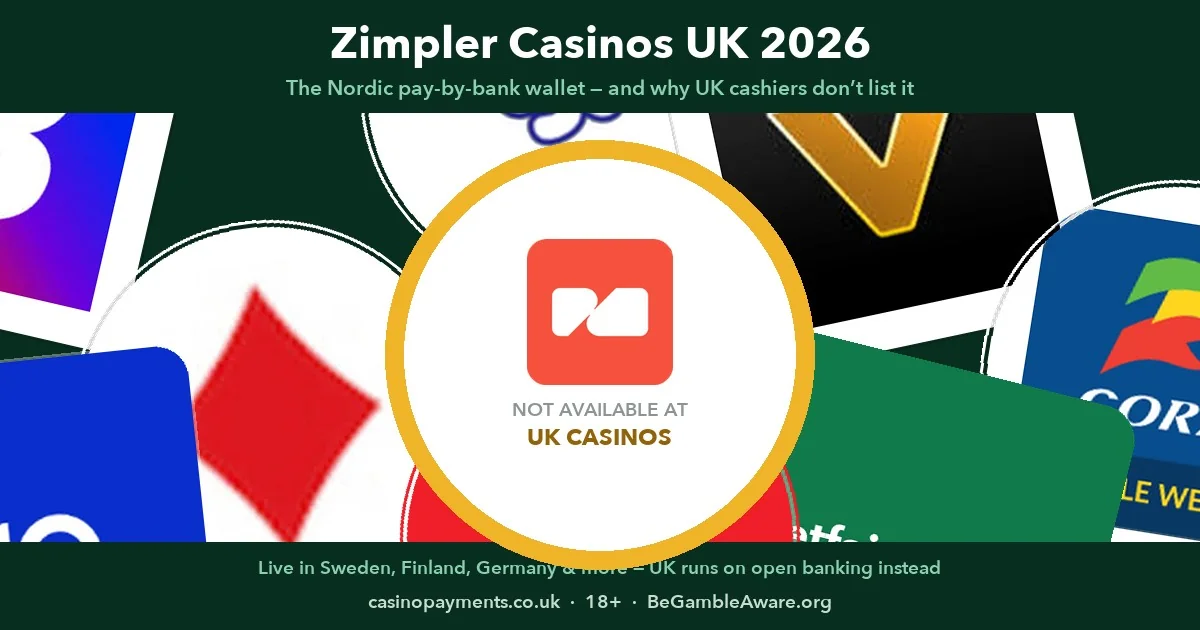
| Can UK players use Zimpler at casinos? | No. Zimpler does not serve UKGC-licensed casinos — there is no Zimpler option in any legitimate British cashier |
| Where does it work? | Sweden and Finland above all, plus licensed markets across the EU, the Baltics and Brazil |
| What does the same job here? | Open banking pay-by-bank — the identical account-to-account, no-card idea on UK rails |
| Sites advertising "Zimpler UK casinos"? | Marketing unlicensed offshore operators — every UKGC protection is absent there; close the tab |
| Could that change? | Watch the TrueLayer connection — the UK's pay-by-bank leader was reported acquiring Zimpler in 2026 |
So this page does something different: it explains what Zimpler is and why Nordic players rave about it, then maps every piece of that experience onto the methods that actually exist in UK cashiers — because the thing Zimpler does brilliantly is alive and well here, just wearing different branding.
Status verified 5 July 2026 · 18+ · UKGC-licensed operators only · begambleaware.org
Zimpler: Quick Facts
| Category | Account-to-account (pay-by-bank) payment system |
|---|---|
| Founded | 2012, Gothenburg, Sweden |
| Regulation | Licensed payment institution under Swedish supervision, passported across the EEA |
| Signature trick | Bank-ID authentication doubling as casino registration — the Pay N Play model |
| UK availability | None — no UKGC casino lists Zimpler |
| Heartland | Sweden and Finland; wider EU, Baltic and Brazilian presence |
| Speeds where available | Deposits instant; withdrawals often minutes at Pay N Play operators |
| UK equivalent | Open banking pay-by-bank — same architecture, British rails |
| 2026 development | Acquisition by TrueLayer (the UK’s pay-by-bank leader) reported — the first real UK connection |
Pay N Play: The Idea That Made Zimpler Famous
Zimpler’s fame rests on a genuinely clever inversion. At a Nordic Pay N Play casino there is no registration form: you deposit first, authenticating with your national bank identity (Sweden’s BankID, Finland’s bank credentials), and that single act is the registration — the bank identity supplies your verified name, age and account in one cryptographic handshake. Land on a casino, deposit in thirty seconds, play; withdrawals reverse down the same verified pipe in minutes.
The trick depends on infrastructure Britain doesn’t have: a universal, government-recognised bank identity scheme. The UK’s open banking provides the payment half — account-to-account transfers with app authentication — but not the identity half, so UK casinos still run their own registration and verification even when the money moves bank-to-bank. That, in one paragraph, is why Pay N Play never crossed the North Sea, why “no-registration UK casino” adverts are always either misleading or unlicensed, and why Zimpler’s absence here is structural rather than commercial reluctance.
Zimpler vs Its UK Equivalents
Every part of the Zimpler experience exists in a UK cashier — distributed across methods rather than bundled.
| What Zimpler does | The UK method that does it | How close is the match? |
|---|---|---|
| Bank-to-bank deposits, no card | Open banking | Near-identical — same architecture, app authentication instead of BankID |
| Withdrawals in minutes | Open banking at fast-payout operators | Close — Faster Payments delivers once the operator approves |
| No card numbers shared | Open banking, pay by mobile | Full match |
| Deposit-as-registration | Nothing — UK verification rules require separate signup | The one genuinely missing piece |
| Phone-number-simple deposits | Pay by mobile (Boku/Fonix) | Partial — simpler even than Zimpler, but deposit-only with a ~£30 cap |
The framing worth keeping: UK players aren’t missing Zimpler’s payments — open banking is the same idea on British rails, often faster. What Britain lacks is the identity layer, and that costs a one-time registration per casino rather than any ongoing friction. Nordic envy, on inspection, mostly evaporates.
How Zimpler Works (Where It Works)
The Nordic deposit, step by step
- Pick Zimpler in a Swedish or Finnish cashier — often the default, sometimes the only option at Pay N Play brands.
- Authenticate with your bank identity — BankID in Sweden, bank credentials in Finland — in a few seconds.
- Approve the transfer; money moves account-to-account and the casino balance credits instantly. At Pay N Play operators this same handshake created your account.
- Withdrawals reverse the flow to the verified account — at the fastest operators, minutes from approval to bank.
Under the hood
Zimpler is an orchestration layer over bank infrastructure: it bundles bank authentication, account-to-account transfer initiation and (for Pay N Play) identity hand-off to the operator into one API. That’s the same structural role TrueLayer and its peers play for UK open banking — which is exactly why the reported 2026 acquisition of Zimpler by TrueLayer makes industrial sense: the UK’s pay-by-bank leader buying the Nordics’ casino-payments specialist unites two implementations of one idea. Whether that ever produces a Zimpler-branded UK product is speculation; the plumbing convergence is already fact.
Zimpler’s Licensing and Bank-Grade Verification
In its home markets Zimpler operates as a licensed payment institution under Swedish financial supervision, passported across the EEA — the payments-regulation tier above e-money in several respects, since funds move bank-to-bank without ever pooling in a wallet. The security model inherits the banks’: national bank-identity authentication is among the strongest consumer verification schemes anywhere, and no card numbers or credentials ever reach the merchant. There’s no balance to safeguard because there’s no balance at all — the same structural advantage UK open banking enjoys.
For UK readers the security section has a different job: any site offering Zimpler to British players is by definition not UKGC-licensed, and carries none of the protections this site assumes everywhere — no GAMSTOP, no dispute rights, no player-fund segregation rules, no affordability safeguards. The payment method being impeccably regulated does nothing for you when the casino isn’t; Swedish payment supervision does not reach into an unlicensed operator’s conduct. The safest possible reading of a “Zimpler UK casino” advert is as a licence-status disclosure: it has just told you the site is offshore.
From Gothenburg Startup to Nordic Standard
Zimpler’s history is the Pay N Play era in miniature.
- 2012 — Founded in Gothenburg as PugglePay, a mobile-billing payments startup in the Payforit mould.
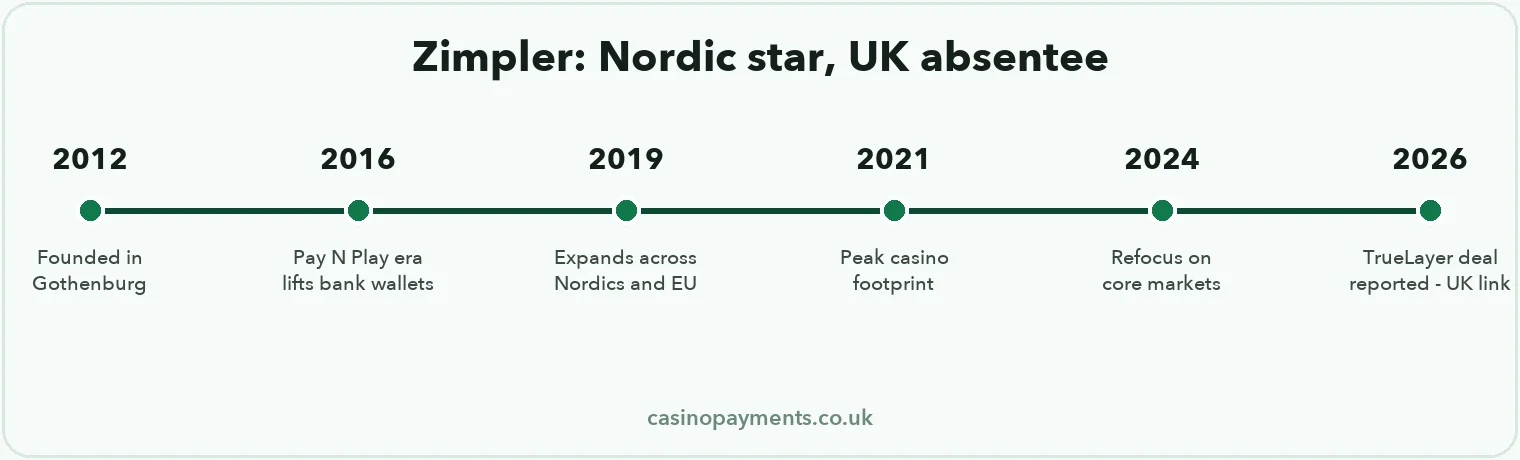
- 2016 — Rebrands as Zimpler and pivots toward bank payments as Sweden’s BankID infrastructure matures — the decisive bet.
- 2017–2019 — The Pay N Play wave: Trustly pioneers it, Zimpler becomes the strong second, and no-registration casinos sweep the Nordics.
- 2019 — Sweden’s re-regulated gambling market channels play through licensed operators — with bank-payment rails as the compliance backbone, entrenching Zimpler further.
- 2021–2023 — Expansion across EU licensed markets, the Baltics and Brazil; the product broadens beyond gambling.
- 2024–2025 — Consolidation years in a maturing pay-by-bank sector.
- 2026 — The TrueLayer acquisition is reported — the Nordic specialist joining the UK’s open-banking leader, and the first plausible path to any UK relevance.
The PugglePay footnote deserves its irony: Zimpler began in the same phone-billing business as Britain’s Payforit — then escaped that dead end by betting on bank rails, which is precisely the migration the UK market made without it.
Where Zimpler Actually Works
The live map, market by market: Sweden is the heartland — ubiquitous in licensed cashiers, BankID-native, the reference implementation. Finland matches it in depth through bank-credential authentication. Licensed markets across the EU — Germany, the Netherlands, Spain, Italy, Austria among them — carry it wherever local regulation and bank infrastructure cooperate. The Baltics and Brazil round out the growth column, the latter riding Pix, Brazil’s astonishing instant-payment network. The UK’s absence from that list isn’t oversight, and this page’s earlier sections explain the identity-infrastructure reason. One practical warning completes the map: Zimpler’s Nordic fame makes its name a favourite lure on offshore sites targeting British players — if a cashier offers Zimpler to a UK address, the operator is unlicensed here, and every consumer protection you’d rely on is absent. Licensed markets only, whichever side of the North Sea you’re on.
Zimpler Outside the Casino Cashier
Zimpler’s post-2021 story is deliberate diversification away from gambling dependence: e-commerce checkout, subscription billing, payouts for gig platforms and marketplaces — anywhere account-to-account transfers undercut card fees, which increasingly means everywhere. Brazil’s Pix integration turned it into a genuine cross-continental player, and the reported TrueLayer deal would fold all of it into the company already powering much of British pay-by-bank — including, in all likelihood, some of the open-banking deposits this site’s UK readers already make without ever seeing either brand name. That’s the quietly satisfying ending to the “why can’t I use Zimpler?” question: if the acquisition completes as reported, British players may end up using Zimpler’s technology daily — inside cashiers labelled simply “pay by bank”, which is where this page’s alternatives section has been pointing all along.
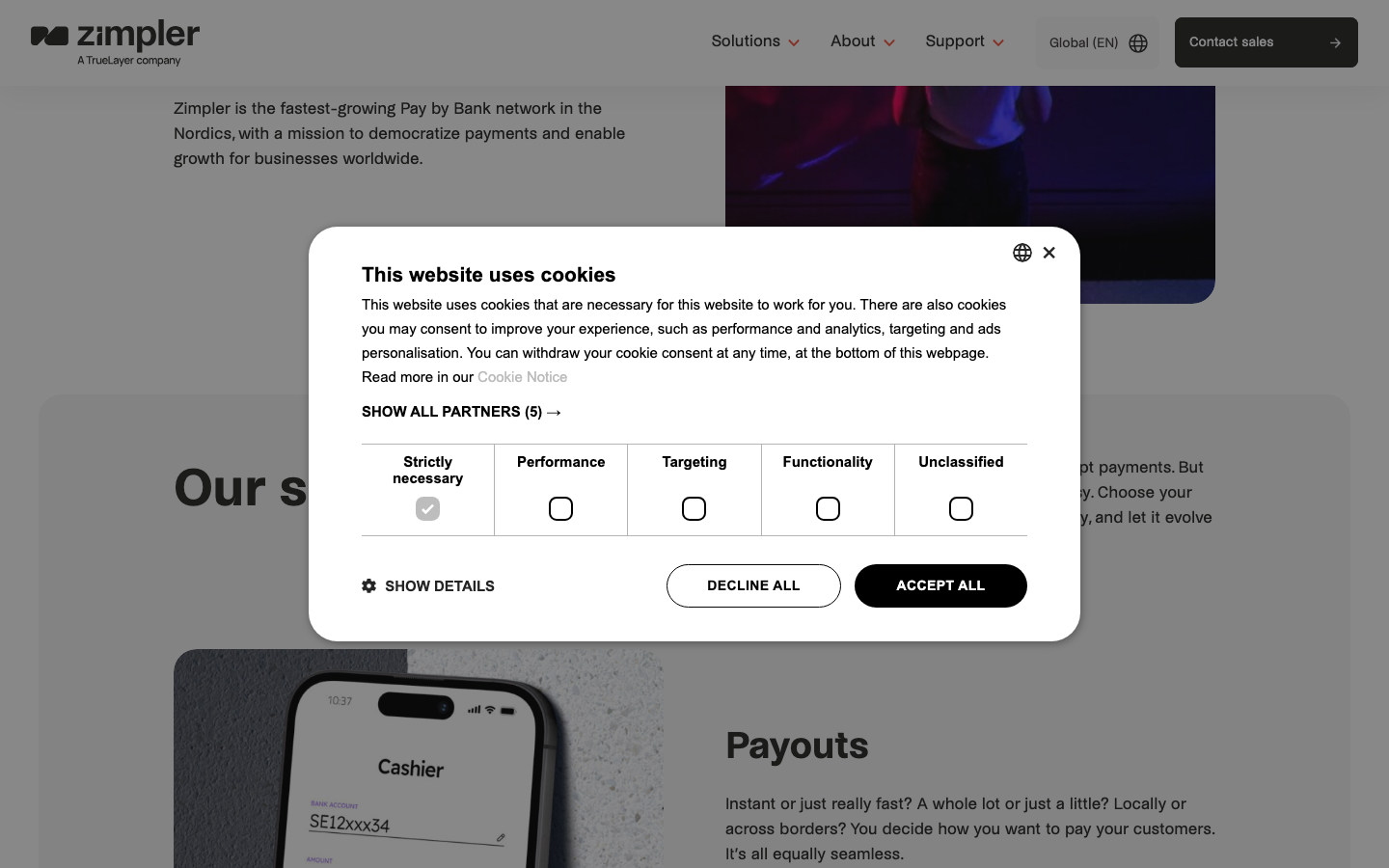
Update, confirmed directly this month: Zimpler’s own homepage no longer hedges the TrueLayer relationship as a pending deal — its masthead now reads simply “Zimpler, a TrueLayer company,” alongside positioning as “the fastest-growing Pay by Bank network in the Nordics.” What was reported as an acquisition-in-progress is, on the company’s own current branding, complete.
Zimpler & Safer Gambling
In its home markets, Zimpler’s model is arguably safer-gambling-positive: bank-visible transactions (every deposit sits on your bank statement, catchable by bank-level blocks), no credit anywhere in the chain, and identity-verified play from the first krona — the transparency profile UK open banking shares. Sweden’s licensed regime layers Spelpaus, the national self-exclusion register, on top, exactly as GAMSTOP works here.
For UK readers the safer-gambling point is starker and worth stating twice: the only way a British player encounters Zimpler is at an unlicensed offshore casino, and those sites sit outside every protection — GAMSTOP exclusions don’t bind them, deposit-limit rules don’t exist there, affordability checks never trigger, and disputed winnings have no ombudsman. For anyone managing their gambling, offshore sites aren’t a payment-method question at all; they’re the failure mode. Stay inside the UKGC perimeter, use open banking for the same bank-rail transparency, and take the full toolkit from our responsible gambling hub. The National Gambling Helpline — 0808 8020 133 — is free, confidential, 24/7. 18+.
What Players Say About Zimpler
Nordic player sentiment is about as good as payment-method commentary gets: Swedish and Finnish forums treat Zimpler as invisible infrastructure, and the Pay N Play experience — “deposited and playing before an English site would have finished emailing me a verification link” — is the recurring boast. Complaints exist and are instructive in their smallness: occasional bank-side authentication hiccups, and the structural gripe that bank-visible gambling transactions are exactly what some players wanted wallets to avoid — transparency reads as a feature or a bug depending on who’s reading.
The UK-flavoured threads are a different genre: players asking where to find Zimpler casinos, and — more darkly — players who followed an affiliate link to an offshore “Zimpler UK” site and are now asking how to recover confiscated winnings from an operator no regulator will make answer. Those threads end the same way every time, and this page exists partly so fewer of them start: the method was never the problem; the missing licence was. British players wanting what Nordic players have should read the alternatives below, not the second page of search results.
The UK Alternatives That Do Zimpler’s Job
Match the piece of Zimpler you wanted to the method that delivers it at UKGC casinos:
- Bank-to-bank, no cards, fast payouts — Open banking: the direct equivalent, app-authenticated, free, with Faster Payments withdrawals that rival Nordic speeds at quick-approval operators. If you wanted Zimpler, you want this.
- Maximum deposit simplicity — Pay by mobile: nothing to authenticate but your phone number, with the ~£30 daily cap as built-in discipline; deposit-only, like Zimpler’s ancestor PugglePay.
- Bank-grade money with a privacy layer — PayPal or Jeton: account-to-account speed with a wallet between your bank and the casino.
- The familiar default — Debit cards: not Zimpler-like at all, but the baseline everything above competes with.
Making the switch takes minutes:
- Open your regular casino’s cashier and pick the bank-transfer / pay-by-bank option.
- Choose your bank from the list and approve the connection in your banking app — no card numbers, no forms.
- Deposit; then request your first withdrawal to the same account to see the Faster Payments leg for yourself.
Open banking is the answer for nine readers in ten — and unlike a North Sea import, it’s already in the cashier of essentially every casino this site reviews.
Zimpler Myths UK Players Keep Meeting
Four claims that circulate wherever “Zimpler UK” gets searched, each worth puncturing precisely:
“Zimpler is coming to UK casinos soon.” This rumour predates half the pages spreading it. Nothing structural has changed: the Pay N Play model still needs a bank-identity scheme Britain doesn’t run, UK verification rules still require separate registration, and Zimpler’s commercial map still points at markets where its model works natively. The TrueLayer development is genuinely interesting — and is about plumbing, not a branded UK cashier launch. Treat any page announcing “Zimpler UK casinos 2026” as marketing an offshore site or recycling a rumour.
“You can use Zimpler from the UK with a workaround.” The method authenticates against Nordic and EU bank identities; a British bank account isn’t a supported credential, and a UK player “using Zimpler” is really using an unlicensed casino’s cashier theatre. There’s no VPN trick around not having a Swedish BankID.
“Zimpler casinos pay out faster than UK casinos ever can.” Nordic payout speed is real but the comparison is stale: UK open banking withdrawals at quick-approval operators land on Faster Payments timelines that match or beat it. The speed gap was an era, not a law of nature — and the era ended.
“It’s the same as Trustly, so it must work here.” Adjacent, not identical — and instructive: Trustly’s UK gambling presence also runs through open-banking-style rails under UK rules rather than the Nordic Pay N Play model. The lesson generalises: bank-payment brands cross the North Sea; the no-registration model doesn’t.
The pattern across all four: every myth sells the idea that the Nordic experience is one clever trick away. It isn’t — but its best parts are one honest setup away, in the alternatives above.
Zimpler vs Trustly: The Instructive Comparison
The Nordic pay-by-bank story has two protagonists, and their diverging UK fates teach the page’s lesson better than any argument. Trustly — Swedish like Zimpler, Pay N Play’s actual pioneer — did cross the North Sea: it built UK open-banking integrations, adapted to a market where deposit-as-registration is impossible, and operates here as a bank-payment rail inside the standard registration-then-verify UK flow. Zimpler stayed closer to home, doubling down on the markets where its bank-identity model works natively.
Neither choice was wrong; together they map the terrain. What crossed the water with Trustly was exactly the portable half of the Nordic model — account-to-account transfers, bank-app authentication, fast payout rails. What stayed behind with Zimpler was the half that needs national infrastructure: BankID-style identity, and the no-registration casino experience built on it. A UK player comparing their own open-banking deposits with a Swedish friend’s Zimpler ones is looking at the same plumbing separated by an identity scheme, not a technology gap.
The comparison also sharpens the TrueLayer speculation usefully: TrueLayer already is, roughly, Britain’s Trustly-equivalent at the infrastructure layer. Acquiring Zimpler buys Nordic market depth and casino-vertical expertise — not a mechanism for importing Pay N Play into a regulatory environment that structurally excludes it. Anyone promising otherwise is selling the myth this page’s earlier section retired. The realistic best case for UK players remains what it was: better-engineered pay-by-bank inside the rules we have — which, as the alternatives section says, is already most of what there was to envy.
Our Verdict on Zimpler for UK Players
Zimpler earns real admiration and no score: you can’t rate a cashier option that isn’t in any legitimate British cashier. As a product it’s excellent — the Nordic Pay N Play model it helped build is the best deposit experience in regulated gambling anywhere, and its bank-rail transparency is a safer-gambling asset. As a UK option it’s a mirage kept alive by offshore marketing, and the correct response to any “Zimpler UK casino” pitch is to recognise it as an unlicensed-operator disclosure. The constructive verdict: take the thirty seconds you’d have spent searching for it and set up open banking at your regular casino instead — same idea, British rails, full UKGC protection. And keep half an eye on the TrueLayer story; if any path brings Zimpler’s technology into UK cashiers, that’s the one, and this page will be updated the month it happens.
Zimpler Casino FAQs
Can I use Zimpler at UK online casinos?
No. Zimpler doesn’t serve UKGC-licensed operators, so no legitimate British cashier offers it. Any site advertising Zimpler to UK players is operating offshore without a UK licence — which removes GAMSTOP, dispute rights and every other protection.
What is Zimpler?
A Swedish pay-by-bank system founded in 2012: deposits move account-to-account with bank-identity authentication, and at Nordic Pay N Play casinos the first deposit doubles as registration. Think of it as the Nordic cousin of UK open banking.
Why isn’t Zimpler available in the UK?
The Pay N Play model needs a universal bank-identity scheme like Sweden’s BankID, which Britain doesn’t have, and UK verification rules require separate registration regardless. The payments half of Zimpler’s job is already done here by open banking.
What’s the UK equivalent of Zimpler?
Open banking pay-by-bank — the same account-to-account architecture with banking-app authentication, free at essentially every UKGC casino, with Faster Payments withdrawals. Our open banking guide covers it in full.
What is Pay N Play?
The Nordic model where depositing via bank identity creates and verifies your casino account in one step — no registration form. Trustly pioneered it, Zimpler became the strong second. UK rules require separate registration, so it doesn’t exist here in licensed form.
Is Zimpler safe?
In its licensed markets, very: it’s a supervised Swedish payment institution, money moves bank-to-bank with no stored balance, and no card details ever reach the merchant. Safety of the method never transfers to unlicensed casinos offering it, though — the operator’s licence is what protects you.
Which countries can use Zimpler for gambling?
Sweden and Finland are the heartland, with coverage across licensed EU markets including Germany, the Netherlands, Spain, Italy and Austria, plus the Baltics and Brazil. The UK is not on the list.
What is the Zimpler–TrueLayer connection?
TrueLayer — the UK’s leading open-banking payments provider — was reported in 2026 to be acquiring Zimpler, uniting the Nordic casino-payments specialist with British pay-by-bank infrastructure. It’s the first realistic route by which Zimpler technology could reach UK cashiers.
A site is offering me a “Zimpler UK casino” — is it legit?
No. Since Zimpler doesn’t serve UKGC operators, that offer is itself proof the site is unlicensed for British players. Winnings there are confiscatable with no ombudsman, GAMSTOP doesn’t apply, and this site’s advice is simple: close the tab.
Did Zimpler used to be a phone-billing company?
Yes — it launched in 2012 as PugglePay, a mobile-billing startup in the same mould as Britain’s Payforit, then rebranded and pivoted to bank payments in 2016 as Sweden’s BankID matured. The pivot is why it thrived while phone-billing brands faded.
Does Zimpler work for anything besides gambling?
Yes — its post-2021 diversification pushed into e-commerce checkout, subscriptions and marketplace payouts across its licensed markets, plus Brazil via Pix. None of that changes its UK gambling position: no UKGC cashier lists it for deposits.
Is Trustly the same thing as Zimpler?
Adjacent rivals from the same Nordic pay-by-bank wave — Trustly pioneered Pay N Play, Zimpler became the strong second. The instructive difference: Trustly adapted into UK open-banking rails while Zimpler stayed in markets where bank-identity schemes exist, which is why one name appears in British cashiers and the other doesn’t.
If I move to Sweden, can I use Zimpler there?
Yes — with a Swedish bank account and BankID you’d use it like any local, including at Pay N Play casinos under the Swedish licence regime. The method was never blocked for British people; it’s built on infrastructure Britain doesn’t operate.
Does Zimpler charge players fees?
In its live markets the player side is typically free — operators absorb the processing cost, and money moves account-to-account with no wallet balance to attract charges. Academic for UK players, but it mirrors the economics of open banking here: bank-rail methods are the cheap ones everywhere.
Changelog: 9 July 2026 — upgraded a hedged claim to a confirmed fact: Zimpler's own homepage now reads "a TrueLayer company" outright rather than the previously-reported pending acquisition; added an at-a-glance box and an official homepage screenshot.
Sources & Verification
Primary sources checked 5 July 2026: Zimpler’s official product and market documentation (re-verified 9 July 2026, now displaying the completed TrueLayer branding directly); Swedish financial supervisory registers for its payment-institution licensing; 2026 industry reporting on the TrueLayer acquisition; the Gambling Commission’s public register and major operators’ live cashiers confirming Zimpler’s absence from UKGC-licensed sites; TrueLayer’s published materials for the acquisition context; GAMSTOP documentation for the offshore-risk sections.

Will files Zimpler under 'best cashier experience British players can't have' — and after years of fielding the where-can-I-use-it question, wrote this page so the honest answer and the working alternative arrive together. More about Will →