
SticPay and Luxon Pay are two separate, independently-owned e-wallets built around the same niche: fast, multi-currency deposits at online casinos and poker rooms serving an international audience, particularly across Asia. Unlike most methods here, both hold genuine UK FCA authorisation, so there’s no legal barrier keeping them out. What’s kept them off UKGC cashiers is simpler: UK operators standardised on Skrill and Neteller instead. This page explains how each works, why they’re distinct companies, and the UK e-wallets doing the job here.
Why UK Operators Never Adopted SticPay




| SticPay/Luxon Pay at a Glance | |
|---|---|
| UK casino availability | None — UK-facing operators have never adopted either brand |
| Current name | Rebranded Luxon Pay, still operated by Luxon Payments Ltd |
| Where used | International/offshore operators outside UK, US and other tier-1 markets |
| Product scope | Multi-currency wallet, P2P transfers, Mastercard spend |
| UK equivalent | Skrill or MuchBetter |
Checked 5 July 2026 — both wallets are FCA-authorised, so this is a market-adoption gap, not a technical or legal barrier.
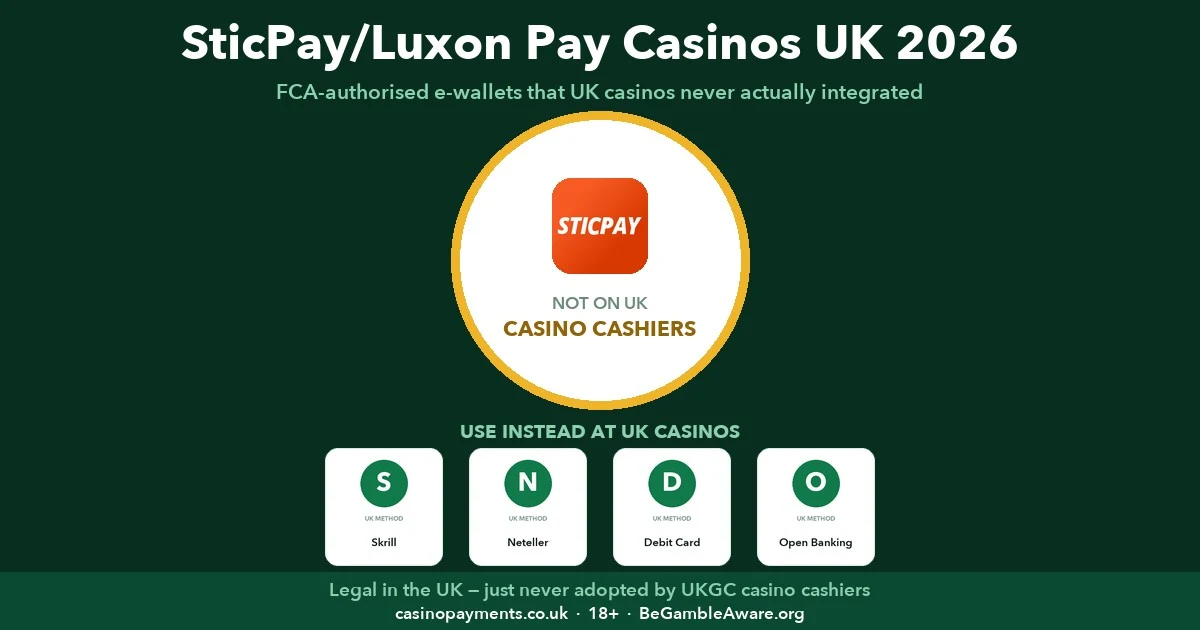
Genuine SticPay casinos holding a UKGC licence simply don’t exist yet, and the same goes for Luxon Pay — the story of why is more interesting than the usual regional excuse.
| Question | The reality |
|---|---|
| Are SticPay and Luxon Pay the same company? | No — they're two separate, independently-owned e-wallets that happen to serve the same global-casino/poker niche |
| Are they legally allowed to operate in the UK? | Yes — both hold UK FCA e-money authorisation, unlike most methods on this site |
| Do UKGC casinos actually offer them? | No — neither appears on the standard UK cashier menu (debit card, PayPal, Skrill, Neteller, paysafecard, open banking) |
| Why not, if they're FCA-authorised? | UK operators simply haven't integrated them — both wallets built their user base around international and Asia-facing casino/poker sites instead |
| What's the UK alternative? | Skrill or Neteller — the e-wallets UK operators actually integrated |
SticPay and Luxon Pay are a genuinely different case from almost everything else on this site: they aren't blocked by currency, banking rails, or a foreign regulator — both are authorised to operate in Britain by the same Financial Conduct Authority that oversees UK banking generally. What's actually going on is simpler and less dramatic: UKGC-licensed operators built their cashiers around Skrill and Neteller instead, and neither SticPay nor Luxon Pay caught on with the mainstream UK casino market the way they did with international and Asia-facing sites.
Facts verified 5 July 2026 · 18+ · UKGC-licensed operators only · begambleaware.org
SticPay/Luxon Pay: Quick Facts
| What they are | Two separate, unrelated multi-currency e-wallets, both popular at international and Asia-facing online casinos and poker rooms |
|---|---|
| SticPay | Founded around 2018, led by CEO Sean Park; licensed by the FCA, Labuan FSA (Malaysia) and Mauritius FSC; available in 190+ countries |
| Luxon Pay | Founded 2018, headquartered in Edmonton, Canada; FCA-authorised in the UK and FINTRAC-registered in Canada; available in 170+ countries |
| UK casino availability | Neither appears on the standard UKGC cashier menu, despite both holding UK FCA authorisation |
| Why not adopted | UK operators built their e-wallet integrations around Skrill and Neteller instead |
| UK equivalents | Skrill and Neteller |
SticPay/Luxon Pay vs UK E-Wallets
On paper, SticPay and Luxon Pay do more or less what Skrill and Neteller do: hold a balance, move it instantly to and from an online casino, support multiple currencies. The real difference isn’t technical capability, it’s which casinos actually plugged them in.
| SticPay/Luxon Pay | Skrill/Neteller (UK) | |
|---|---|---|
| UK regulatory status | FCA-authorised (both) | FCA-authorised (Paysafe Group) |
| Core market | International and Asia-facing casinos, poker rooms | UKGC-licensed casinos, globally recognised e-wallet brands |
| UKGC-casino cashier presence | Effectively none | Standard at the large majority of UK operators |
| Currencies supported | 29-plus (SticPay), multi-currency with exchange (Luxon Pay) | Wide multi-currency support, GBP-native |
That gap in the “cashier presence” row is really the whole story: it isn’t that UK regulation shuts SticPay or Luxon Pay out, it’s that building and maintaining a casino payment integration takes real commercial effort on both sides, and UK operators simply never had a reason to add a second or third e-wallet once Skrill and Neteller were already covering that need.
It’s also worth being clear about what that gap doesn’t mean: it isn’t that UKGC-licensed operators actively refuse SticPay or Luxon Pay on principle, or that either wallet has done anything to disqualify itself from UK gambling specifically. It’s closer to ordinary commercial inertia — once a cashier already covers cards, bank transfer, open banking, Skrill and Neteller, there’s limited appetite for a UK operator to invest in onboarding a further, largely redundant e-wallet option, however well-regulated it is elsewhere.
How SticPay and Luxon Pay Work
Both wallets follow the standard e-wallet pattern: a customer registers an account, verifies their identity, loads funds from a bank transfer, card or (for Luxon Pay) other supported methods, and then uses that balance to deposit instantly at any casino or poker room listing the wallet as a cashier option. Withdrawals run the same way in reverse, landing back in the wallet before the customer moves the funds onward to a bank account or card.
SticPay charges around 3.85% to load via credit card and 2.5% to withdraw to a bank account, plus a $5 monthly inactivity fee after six months of dormancy — a fee structure closer to older-style e-wallets than the fee-free experience Luxon Pay advertises for its core deposit and withdrawal services. Luxon Pay also launched its own Mastercard-branded prepaid card in March 2024, letting a wallet balance be spent directly at any Mastercard-accepting retailer or ATM, similar in spirit to how Play+ or MuchBetter extend an e-wallet balance into everyday spending.
Neither wallet requires a casino-specific sign-up the way, for instance, a Play+ card does in the US: a single SticPay or Luxon Pay account works across every site that lists the wallet as a cashier option, whichever country that site happens to be licensed in, which is closer in spirit to how Skrill and Neteller function for UK players than to the operator-by-operator model some other regional methods on this site use.
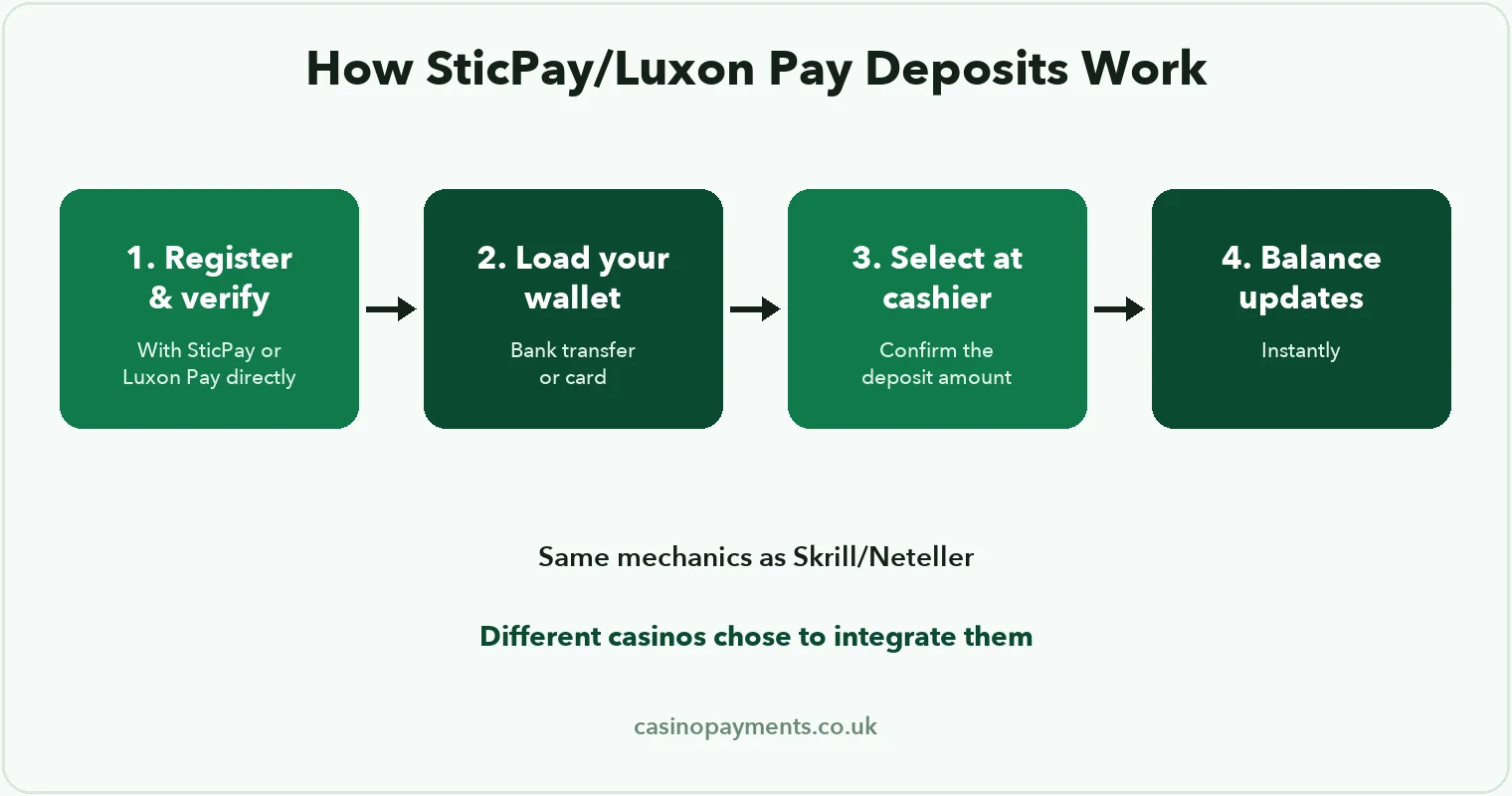
Step by step, a typical deposit with either wallet looks like this:
- Register and verify your identity with SticPay or Luxon Pay directly.
- Load your wallet via bank transfer, card, or another supported method.
- Select the wallet at the casino cashier and confirm the deposit amount.
- Your casino balance updates instantly.
Why UK Casinos Never Adopted Them
This is the section that separates SticPay/Luxon Pay from almost every other method on this site: there’s no currency mismatch, no missing banking rail, and no foreign law keeping them out of Britain. Luxon Payments Limited is registered in the UK and authorised by the FCA as an electronic money institution, the same regulatory category Skrill and Neteller’s parent, Paysafe, operates under; SticPay likewise holds FCA authorisation alongside licences in Labuan (Malaysia) and Mauritius. Both could, in principle, be integrated into a UKGC-licensed casino’s cashier tomorrow.
What’s actually happened is a straightforward market-adoption story rather than a regulatory one: Skrill and Neteller established themselves as the dominant UK-facing e-wallets years before SticPay or Luxon Pay existed, giving UK operators little commercial reason to build and maintain a second integration with a comparable but less UK-recognised wallet. SticPay and Luxon Pay, for their part, focused their own growth on international online casinos and poker rooms — particularly across Asia and other markets less saturated by Skrill and Neteller — rather than competing head-on for UK operator integrations. The result is two legitimately regulated wallets that simply never built the specific relationships needed to appear on a UKGC casino’s payment page, despite having every legal right to.
There’s a useful comparison to draw with how Skrill and Neteller themselves originally grew, since neither started life as a UK-first product either: both built their early reputation partly through international online poker and forex-adjacent payment use cases before becoming the default UK gambling e-wallets they are today. SticPay and Luxon Pay arguably sit at an earlier point on that same kind of trajectory, well-established within their own international niche but not yet (and possibly never) making the specific push into UK casino integrations that would put them on equal footing with Skrill and Neteller domestically.
SticPay’s Licensing and Account Security
Because both SticPay and Luxon Pay hold FCA e-money authorisation, customer funds are subject to the UK’s standard safeguarding rules for e-money institutions, requiring customer balances to be held separately from the company’s own operating funds — the same basic protection that applies to Skrill, Neteller, or any other FCA-regulated e-wallet. Both wallets also run standard identity-verification checks at registration, consistent with UK and international anti-money-laundering requirements.
The practical security consideration for a UK reader isn’t about either wallet’s own safety so much as where they’re actually being offered: since no mainstream UKGC-licensed casino lists SticPay or Luxon Pay, any UK-facing site inviting a British player to use one is worth treating with the same caution as any other payment method offered outside the standard UK cashier menu — not because the wallet itself is unsafe, but because it signals the site may be operating outside UKGC licensing.
It’s worth drawing the distinction sharply: an unregulated cash-voucher scheme with no licensing at all is a very different risk from a genuinely FCA-authorised wallet like SticPay or Luxon Pay simply being offered by a site that itself lacks a UKGC licence. The payment method passing regulatory muster doesn’t say anything about whether the underlying casino does, which is precisely the kind of distinction worth keeping separate when assessing an unfamiliar site.
SticPay’s Growth in Emerging Payment Markets
SticPay was founded around 2018 under CEO Sean Park, building a multi-currency e-wallet aimed squarely at online casino and poker players across Asia and beyond, and picking up FCA, Labuan Financial Services Authority and Mauritius Financial Services Commission authorisation along the way to support its international customer base. It went on to win a Best Payment Innovation award at the 2023 TrustFinance Awards, reflecting its established position within the gambling-payments industry specifically, even without ever becoming a mainstream UK brand.
That award is worth noting because it underlines something easy to miss from a UK-only vantage point: within the specific world of international online gambling payments, SticPay is a genuinely recognised, credentialed player, not an obscure or fringe option. Its absence from UK cashiers says nothing about its standing elsewhere, only about the particular market UK operators chose to build around instead.
Luxon Pay, despite the superficially similar pitch, developed entirely separately: founded in 2018 and headquartered in Edmonton, Canada, it built out FCA authorisation in the UK and FINTRAC registration in Canada, and expanded its multi-currency, no-fee wallet model to more than 170 countries. In March 2024, Luxon Pay launched a Mastercard-branded prepaid card, extending its wallet balance into everyday retail and ATM spending in a way that mirrors (independently, not through any partnership) what Play+ does for its own US operator-branded cards.
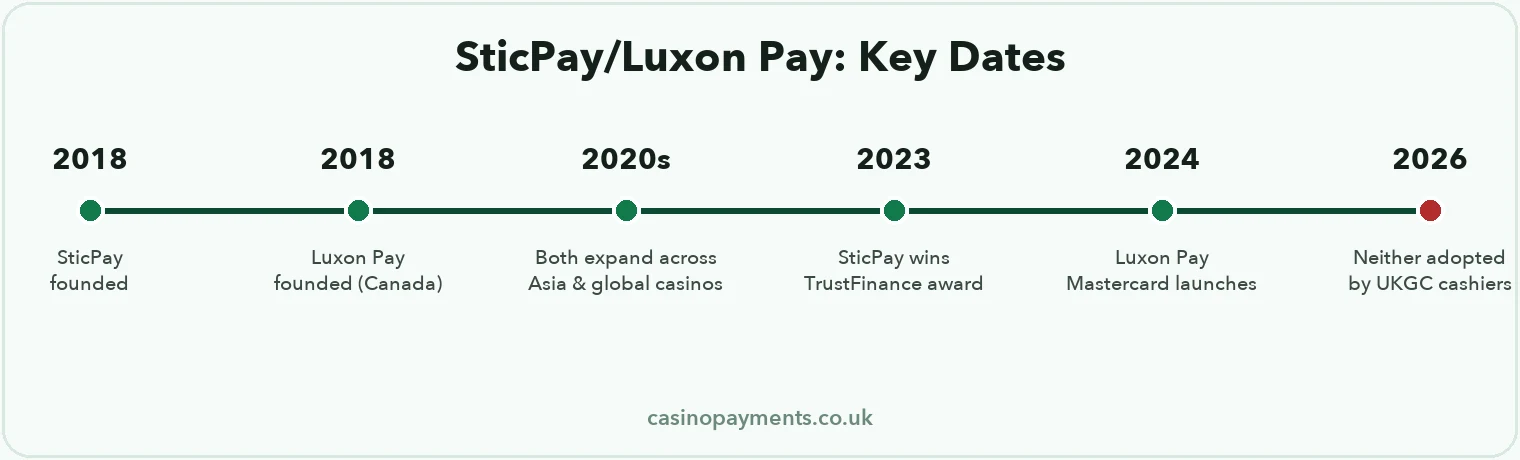
- 2018 — SticPay is founded, led by CEO Sean Park.
- 2018 — Luxon Pay is founded separately, headquartered in Edmonton, Canada.
- 2019 — Both wallets begin building out FCA and international licensing to support cross-border growth.
- 2023 — SticPay wins Best Payment Innovation at the TrustFinance Awards.
- 2024 — Luxon Pay launches its Mastercard-branded prepaid card in March.
- 2026 — Neither wallet has gained meaningful adoption among UKGC-licensed operators, despite both holding FCA authorisation.
Where SticPay and Luxon Pay Work
SticPay operates in more than 190 countries and supports over 29 currencies, though it explicitly excludes a short list of sanctioned or high-risk jurisdictions including Cuba, Iran, Iraq, Liberia, North Korea, Zimbabwe and the United States. Luxon Pay operates in more than 170 countries and territories, with its own published list including Canada, Brazil, Italy, Germany and the UK among supported markets.
Both wallets, in other words, are genuinely available to UK residents to sign up for and use — the gap on this page isn’t jurisdictional the way it is for methods like OXXO or M-Pesa, it’s specifically about which UKGC-licensed casinos have chosen to accept either wallet as a deposit method, which as of this page’s checked date remains effectively none among the mainstream UK-facing operators.
It’s a genuinely unusual position for a payment method to occupy on this site: fully entitled to operate here, actively regulated by the same authority that oversees UK banking, and yet essentially invisible at the specific point (a casino cashier) where a UK player would ever encounter it. Most other regional methods covered here are kept out by something structural — a currency, a banking rail, a foreign law. SticPay and Luxon Pay are kept out by nothing more than which brands got there first.
SticPay and Luxon Pay Beyond Gambling
Both wallets market themselves as general-purpose international payment tools well beyond gambling: SticPay promotes merchant services for e-commerce businesses needing to accept payments across its 190-plus supported countries, while Luxon Pay positions itself for both personal multi-currency transfers and business banking, including a dedicated business product for companies managing international payments and currency exchange.
That broader positioning is part of why neither wallet built a UK-casino-specific push: for both companies, online gambling is one significant customer segment among several, rather than the entire business model the way it is for a more narrowly gambling-focused payment brand, so there was less commercial pressure to chase UK casino integrations specifically when plenty of other international markets and use cases were already driving growth.
SticPay’s merchant-services pitch in particular leans on serving smaller e-commerce businesses across the many countries its wallet reaches, some of which have limited access to conventional card-acquiring infrastructure, echoing (on a much smaller commercial scale) the kind of underserved-market thinking behind M-Pesa, South Africa’s 1Voucher or PayNearMe elsewhere on this site. Luxon Pay’s business banking product, meanwhile, targets companies needing to hold and exchange multiple currencies without opening a traditional multi-currency bank account in each one, a genuinely useful proposition for internationally trading businesses regardless of whether gambling is involved at all.
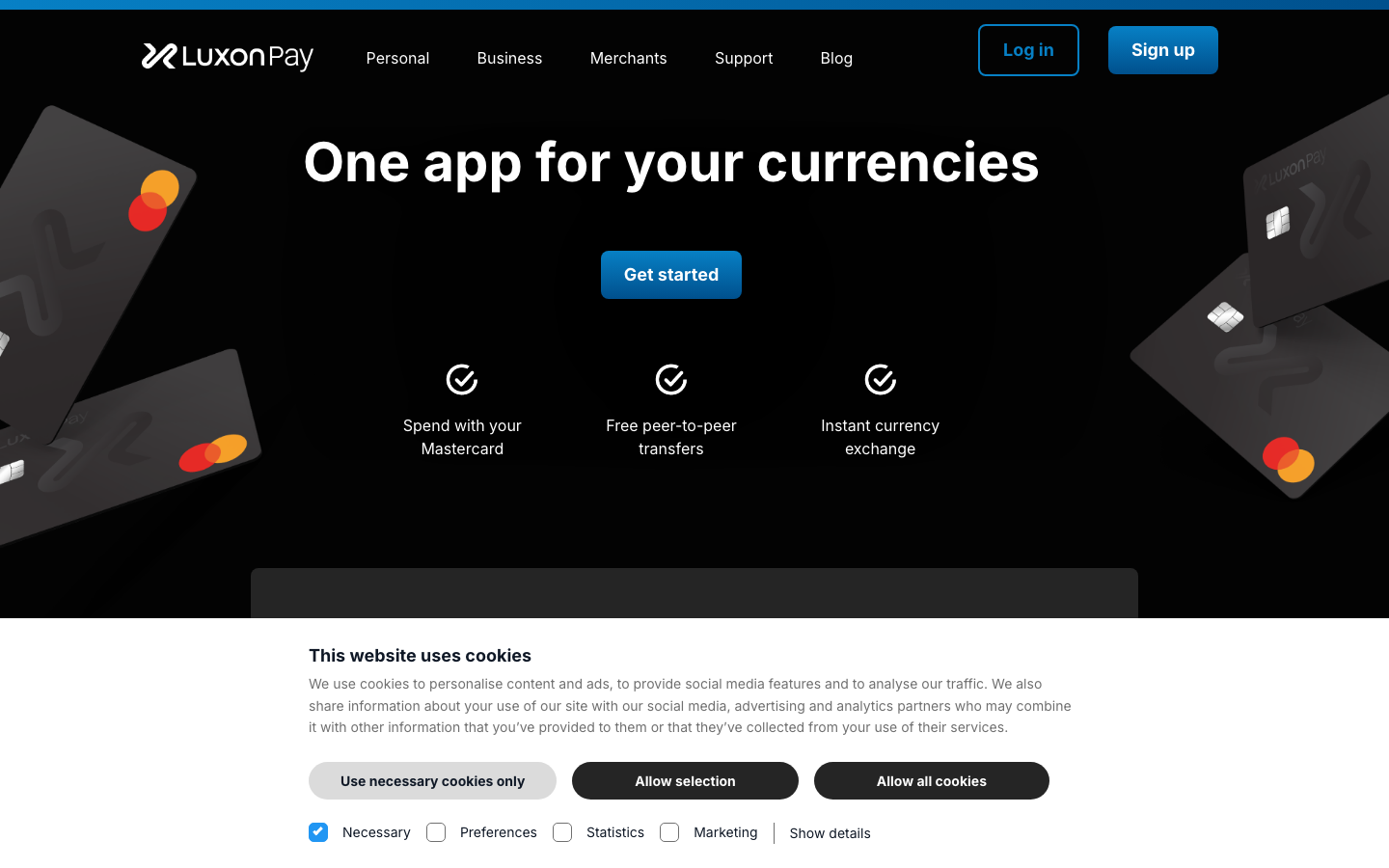
Luxon Pay’s own homepage, checked directly this month: “One app for your currencies” — leading with free peer-to-peer transfers, instant currency exchange and Mastercard spend, consumer-wallet positioning that reads closer to Revolut or Wise than to a gambling-adjacent legacy brand, consistent with the rebrand’s aim of moving past SticPay’s narrower origins.
Safer Gambling and SticPay/Luxon Pay
Because neither wallet appears on a standard UKGC casino cashier, UK-specific tools like GAMSTOP or a bank-arranged gambling block have essentially no everyday interaction with SticPay or Luxon Pay to worry about in the first place — not because the wallets themselves are unsafe, but simply because they aren’t part of the UK gambling payment landscape in practice.
Where this does matter is as a signal: since these wallets are genuinely legitimate and FCA-authorised, their appearance at a site targeting UK players isn’t itself a red flag the way an unregulated cash-voucher scheme might be — but their absence from every mainstream UKGC operator’s cashier means a UK player encountering either wallet at a gambling site should still check that the operator itself holds a genuine UKGC licence before depositing, since a legitimate payment method doesn’t guarantee a legitimate operator.
What International Bettors Say
Player discussion of SticPay and Luxon Pay is concentrated heavily among international casino and, especially for Luxon Pay, online poker communities, where both wallets are well regarded for fast processing and broad currency support across markets that Skrill and Neteller don’t always serve as smoothly. SticPay’s fee structure (3.85% card loading, 2.5% withdrawal, and the $5 inactivity fee) draws more frequent complaint than Luxon Pay’s fee-free positioning, which tends to be cited as one of its main selling points among poker players moving funds across multiple currencies and sites.
None of that discussion touches UK-licensed gambling in any meaningful way, since it describes an international player base using either wallet at sites that mostly sit outside UKGC licensing altogether.
Where the two wallets’ reputations diverge most is speed of customer support: Luxon Pay’s poker-community following in particular tends to praise responsive, specialist support familiar with high-value, frequent transactions typical of serious online poker players, while SticPay reviews are more mixed on support responsiveness, though generally positive on the wallet’s core transaction reliability across the wide range of currencies and countries it serves.
The UK Wallets That Do SticPay’s Job Better
Skrill and Neteller are the direct UK equivalents — both are FCA-authorised e-wallets (under the same Paysafe Group) doing exactly what SticPay and Luxon Pay do elsewhere, and both are standard, widely-integrated cashier options at UKGC-licensed casinos.
Using Skrill or Neteller at a UK casino follows the same basic pattern SticPay and Luxon Pay use internationally:
- Register and verify your Skrill or Neteller account.
- Load your wallet from a UK bank account or debit card.
- Select it at the casino cashier and confirm your deposit.
- Your balance updates instantly, with UK-mainstream support if anything goes wrong.
The practical advantage over SticPay or Luxon Pay for a UK player isn’t regulatory — both alternatives are just as legitimately authorised — it’s simply that Skrill and Neteller are the ones every UKGC-licensed casino has actually built a cashier integration for.
For anyone specifically drawn to Luxon Pay’s no-fee model or its Mastercard-linked spending, it’s worth noting that most UK debit cards and open banking transfers are themselves fee-free at the casino end too, with any card charges typically coming from the issuing bank rather than the payment method itself — so the fee-free appeal that helps Luxon Pay stand out internationally isn’t actually a gap in the UK market the way it might be elsewhere.
Our Verdict on SticPay/Luxon Pay for UK Players
SticPay and Luxon Pay are two separate, genuinely legitimate, FCA-authorised e-wallets that happen to share a similar pitch and a similar international-casino customer base, without being the same company or having any formal connection to each other. Unlike most methods on this site, nothing about UK law or banking infrastructure keeps them out of Britain — it’s simply that UK operators built their cashiers around Skrill and Neteller instead. UK players wanting the same multi-currency e-wallet experience should use Skrill or Neteller, both already standard at UKGC-licensed casinos.
SticPay/Luxon Pay Casino FAQs
Is SticPay the same company as Luxon Pay?
No — they’re two separate, independently-owned e-wallets that happen to serve a similar international casino and poker niche. There’s no rebrand or ownership connection between them.
Can I use SticPay or Luxon Pay at a UK online casino?
In practice, no — neither appears on the standard cashier menu at mainstream UKGC-licensed casinos, even though both are legally authorised to operate in the UK by the FCA.
Why don’t UK casinos accept SticPay or Luxon Pay if they’re FCA-authorised?
It’s a market-adoption gap, not a legal one — UK operators standardised their e-wallet cashiers around Skrill and Neteller years ago, and neither SticPay nor Luxon Pay built the specific integrations needed to compete for that UK business.
Are SticPay and Luxon Pay safe to use?
Both hold genuine e-money authorisation (SticPay: FCA, Labuan FSA, Mauritius FSC; Luxon Pay: FCA, FINTRAC) requiring customer funds to be safeguarded separately from company funds, the same protection standard Skrill and Neteller operate under.
What’s the UK equivalent of SticPay or Luxon Pay?
Skrill or Neteller — both are FCA-authorised, multi-currency e-wallets that are actually integrated into UKGC-licensed casino cashiers.
Does SticPay charge fees?
Yes — typically around 3.85% to load via credit card, 2.5% to withdraw to a bank account, and a $5 monthly inactivity fee after six months of dormancy.
Does Luxon Pay charge fees?
Luxon Pay advertises a fee-free model for its core deposit, withdrawal and currency-exchange services, in contrast to SticPay’s fee structure.
Where are SticPay and Luxon Pay most commonly used?
Primarily at international online casinos and poker rooms, with SticPay especially recognised across Asia and Luxon Pay widely used in the online poker community.
Who founded SticPay?
SticPay is led by CEO Sean Park; the company was founded around 2018 and has since built FCA, Labuan FSA and Mauritius FSC authorisation to support its international user base.
Does Luxon Pay have a prepaid card?
Yes — Luxon Pay launched a Mastercard-branded prepaid card in March 2024, letting a wallet balance be spent at any Mastercard-accepting retailer or withdrawn at an ATM.
Changelog: 9 July 2026 — added an at-a-glance box, Luxon Pay's current homepage positioning, and an official homepage screenshot.
Sources & Verification
Checked 5 July 2026 against: SticPay’s own site and licensing information; Luxon Pay’s own site (re-verified 9 July 2026); Companies House records for Luxon Payments Ltd; independent reporting on the Luxon Pay Mastercard launch; and, for UK safer-gambling context, the Gambling Commission’s guidance on blocking gambling payments through your bank.

This is the rare page on this site where the payment method isn't blocked by law, currency or banking rails at all — just by which brands UK operators happened to build relationships with first. More about Will →